

COURREGES WINTER 2026 COLLECTION INSERT
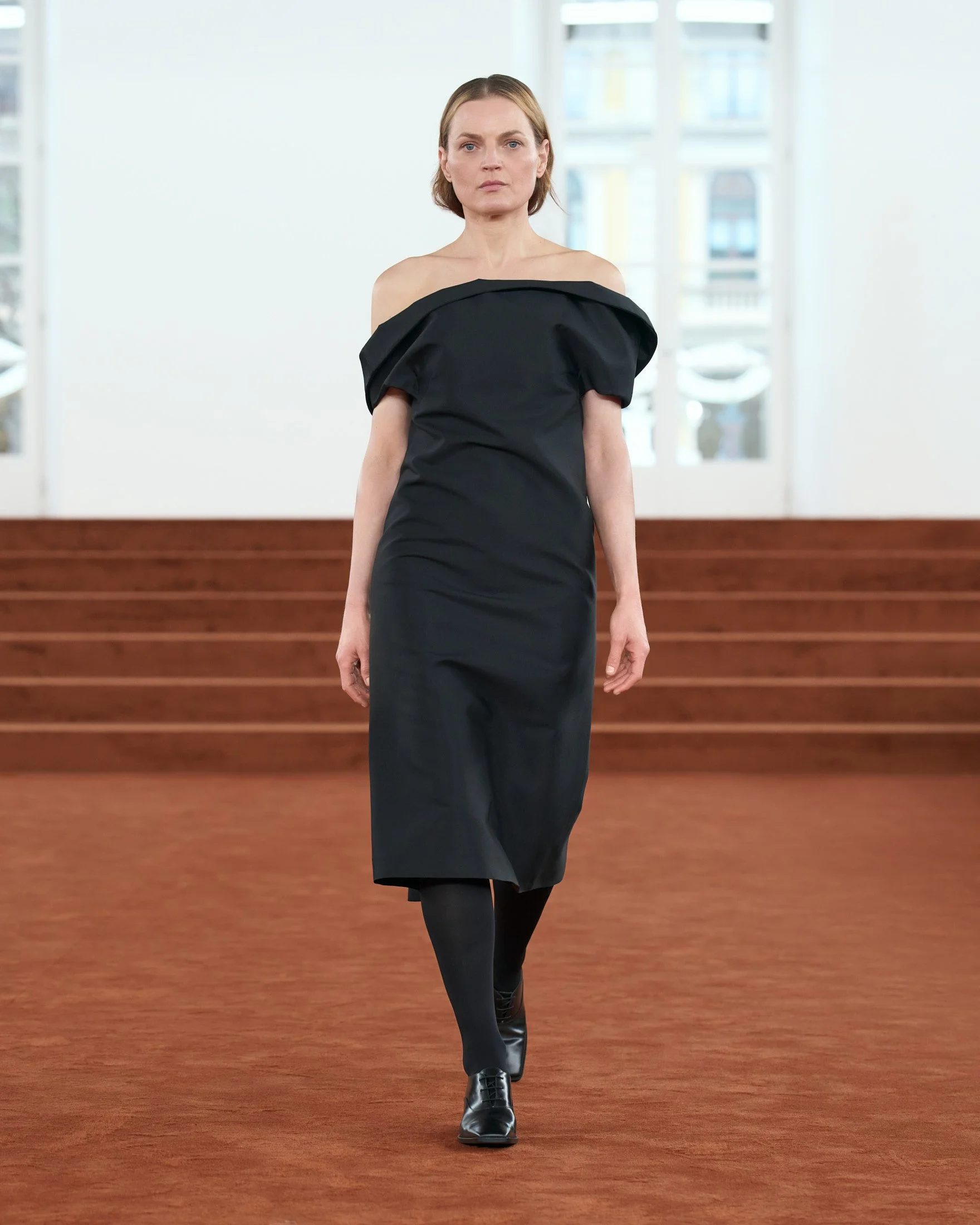
Courtesy of JIL SANDER VIEW LOOKS
JIL SANDER WINTER 2026: THE HOUSE THAT LEARNED TO FEEL
Few fashion houses have cultivated a design language as disciplined and enduring as Jil Sander. For decades, the brand has stood for clarity. A belief that restraint is not the absence of design, but its highest expression. Every seam has purpose. Every silhouette is considered. For Winter 2026, Creative Director Simone Bellotti continues to ask what happens after reduction. If his debut introduced a renewed sense of structure to the house, this second collection explores what emerges once that structure begins to soften. The result is a collection built not around minimalism alone, but around contradiction. Bellotti approached the season through the idea of home. Not home as architecture, but as an emotional landscape. A place capable of offering comfort and tension in equal measure. A place we long to return to and, at times, feel compelled to leave. Home contains memory, familiarity, ritual, and contradiction, all existing simultaneously. It is this emotional complexity that becomes the foundation of Winter 2026. The choice feels significant. Jil Sander has always been associated with discipline. Bellotti asks whether discipline can also accommodate emotion without losing its integrity. Rather than abandoning the codes of the house, he stretches them, allowing rigor to coexist with softness, precision with movement, and order with spontaneity. Throughout the collection, silhouettes begin from familiar foundations before quietly shifting away from expectation. Tailoring remains architectural, but it is no longer entirely linear. Fabrics bend. Curves interrupt straight lines. Volume appears where restraint once dominated. Excess fabric gathers, folds, and drapes around the body, suggesting movement rather than static perfection. Nothing feels arbitrary. Bellotti has spoken about searching for "moreness with meaning." It is an important distinction. Fashion often mistakes excess for expression. Here, every addition serves the same disciplined purpose that subtraction once did. Fabric becomes a gesture rather than ornament. A collar slips backward. A shoulder lifts. Pockets appear to drift away from where convention tells them they should remain. Familiar garments begin to feel quietly unsettled. That tension gives the collection its energy. The dialogue between body and garment becomes increasingly fluid. Clothing no longer simply dresses the wearer; it develops its own sense of movement, almost suggesting an independent life. Dresses float away from the figure before returning to it. Tailoring maintains authority while allowing unexpected softness to emerge. Even upholstery-inspired textiles, a subtle reference to Bellotti's father, who worked as an upholsterer, are transformed into something remarkably light and fluid. The result is a wardrobe that feels deeply physical. Nothing is decorative for decoration's sake. Instead, Bellotti remains interested in how clothing occupies space, how fabric responds to movement, and how proportion can alter our perception of the body without overwhelming it. This attention to physicality has always distinguished Jil Sander from many of its contemporaries. Minimalism is often misunderstood as emotional distance. The house has never truly embraced that interpretation. Since its founding, Jil Sander has pursued purity not to eliminate feeling, but to give it greater clarity. By removing distraction, emotion becomes easier to perceive. Winter 2026 extends that philosophy rather than replacing it. The collection also reflects a broader shift happening across contemporary fashion. After years dominated by overt statements, exaggerated branding, and relentless spectacle, many designers are rediscovering the expressive potential of precision. Bellotti contributes to that conversation without relying on nostalgia. His work feels forward-looking because it resists easy categorization. It is neither strict minimalism nor romantic maximalism. It exists somewhere between the two. That space between opposites is where the collection finds its strongest voice. Menswear and womenswear mirror one another without becoming interchangeable. Structured coats coexist with sculptural softness. Rational tailoring is interrupted by flowing movement. Slashes reveal glimpses of the body, yet never become provocative for their own sake. Exposure functions not as spectacle, but as another form of construction. Even the accessories continue this dialogue. Geometric handbags introduce architectural certainty while subtly echoing the contours of the human body. Footwear moves between exaggerated heels and understated flats, balancing confidence with comfort rather than forcing a choice between them. Perhaps that is Bellotti's most compelling contribution to Jil Sander so far. He understands that modern luxury is no longer defined solely by reduction. It is defined by intention. Every collection must decide what deserves to remain and what deserves to change. Winter 2026 suggests that evolution is not achieved by abandoning a house's identity, but by allowing it to become more emotionally expansive. For a brand built on precision, this is a remarkably human collection. It reminds us that restraint is not the opposite of feeling. Sometimes it is the clearest way to express it.