

APRIL 13TH, 2026
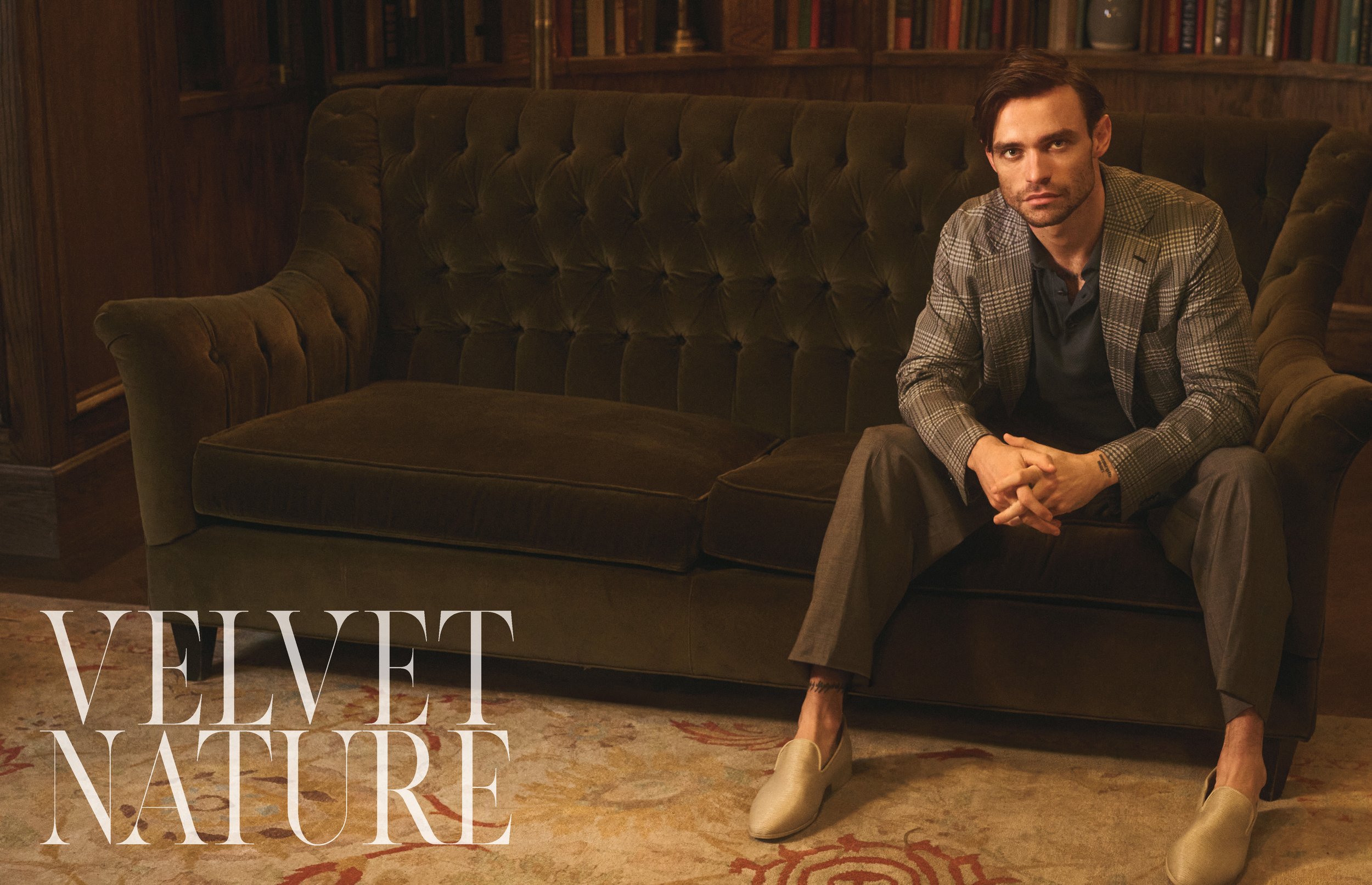
Total look BRIONI, shoes BALLY.
“ IF I HADN’T BECOME AN ACTOR, I PROBABLY WOULD HAVE STUDIED PSYCHOLOGY. THE TWO GO HAND IN HAND.”
— THOMAS DOHERTY
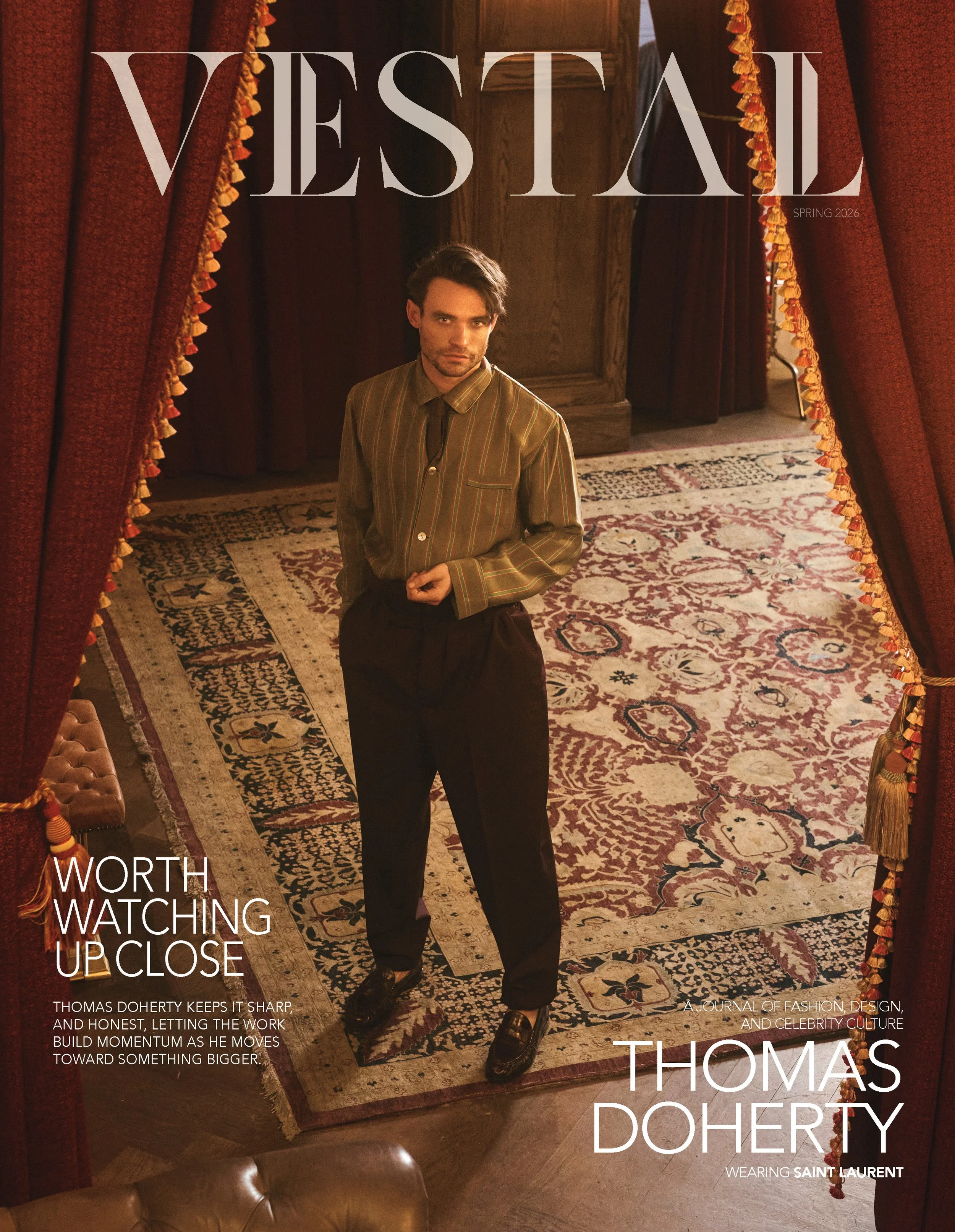
WEARING SAINT LAURENT
In Tribeca, behind an unmarked door and a velvet hush, the afternoon carries the elegance of old New York. The Maxwell Social Club feels less like a venue than a secret inherited from another era: low light gliding across lacquered wood and heavy theatrical curtains that suggest something perpetually about to begin.
In the Grand Room, the atmosphere is thick with a private, salon-like intimacy. On the other side of a stage curtain, a high-profile event hums to life; at one point, the unmistakable silhouette of David Letterman slips past, a reminder that in this city, history is often just a room away. Inside our set, however, the mood is disarmingly calm. Thomas Doherty arrives without an entourage, carrying Daisy Whiskey Doherty, a nine-month-old maltipoo bundle of charm who instantly becomes the unofficial star of the shoot. Between wardrobe changes—the architectural sharp lines of Saint Laurent, the poetic looseness of Dries Van Noten, and the precision of Brioni—Daisy moves through the room with authority. When the camera rolls, she doesn’t just accompany Thomas; she asserts herself with confidence, owning the space alongside him. Between takes, the conversation shifts from the "ominous edge" of survival and the “harsh environment” of his latest project, Paradise, to the tattoos on his skin: “Surrender” and “Is that so?” He isn't interested in the rehearsed cadence of a press cycle; he’s more interested in the Baz Luhrmann-style marathon that is life. As the late-afternoon light fades over Tribeca, what emerges is not a promotional stop, but a portrait of a leading man learning to live comfortably in the gray, grounded by a twelve-pound dog and the kind of persistence that doesn't make for a clean headline.
INTERVIEW WITH THOMAS DOHERTY
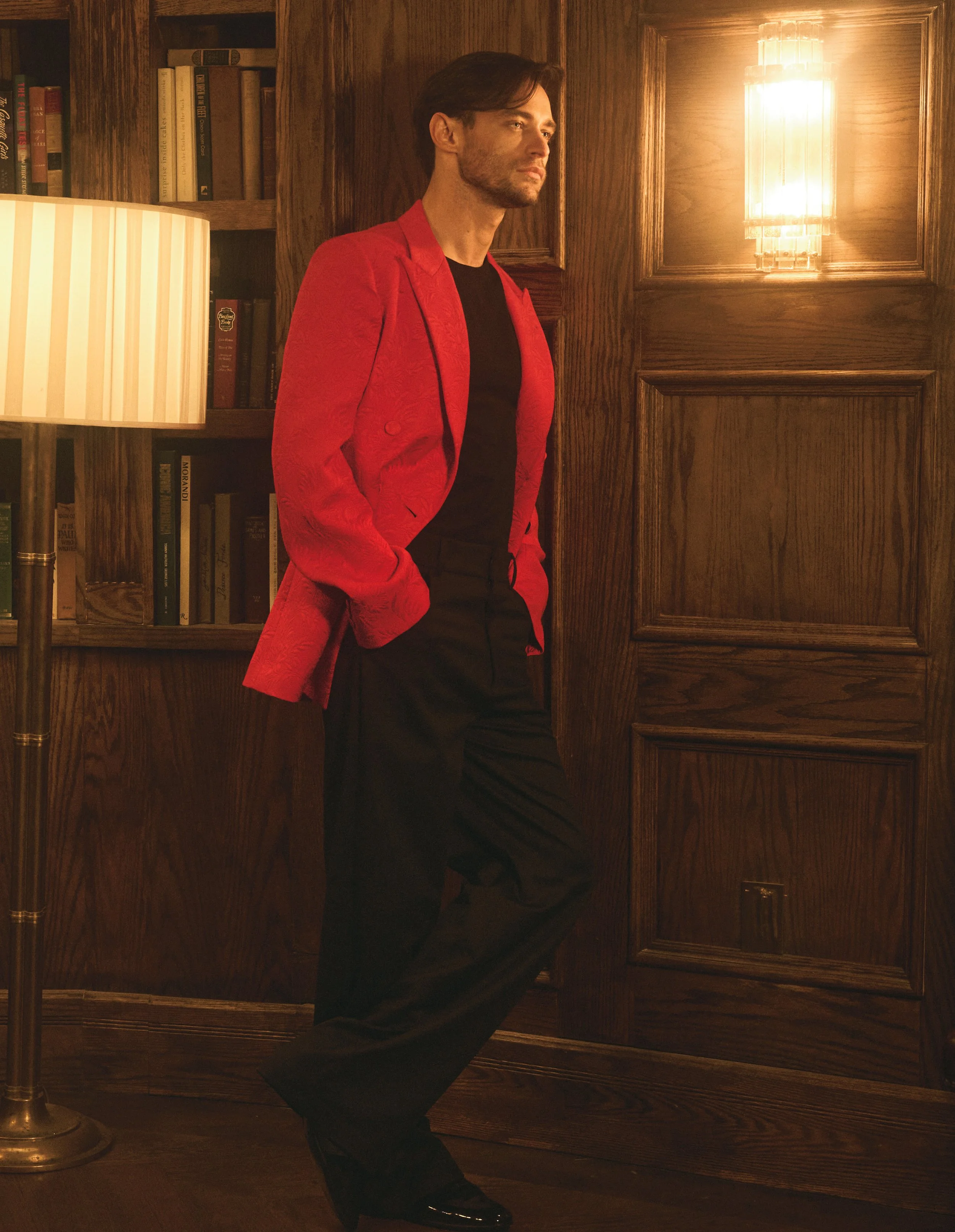
Total look DRIES VAN NOTEN.
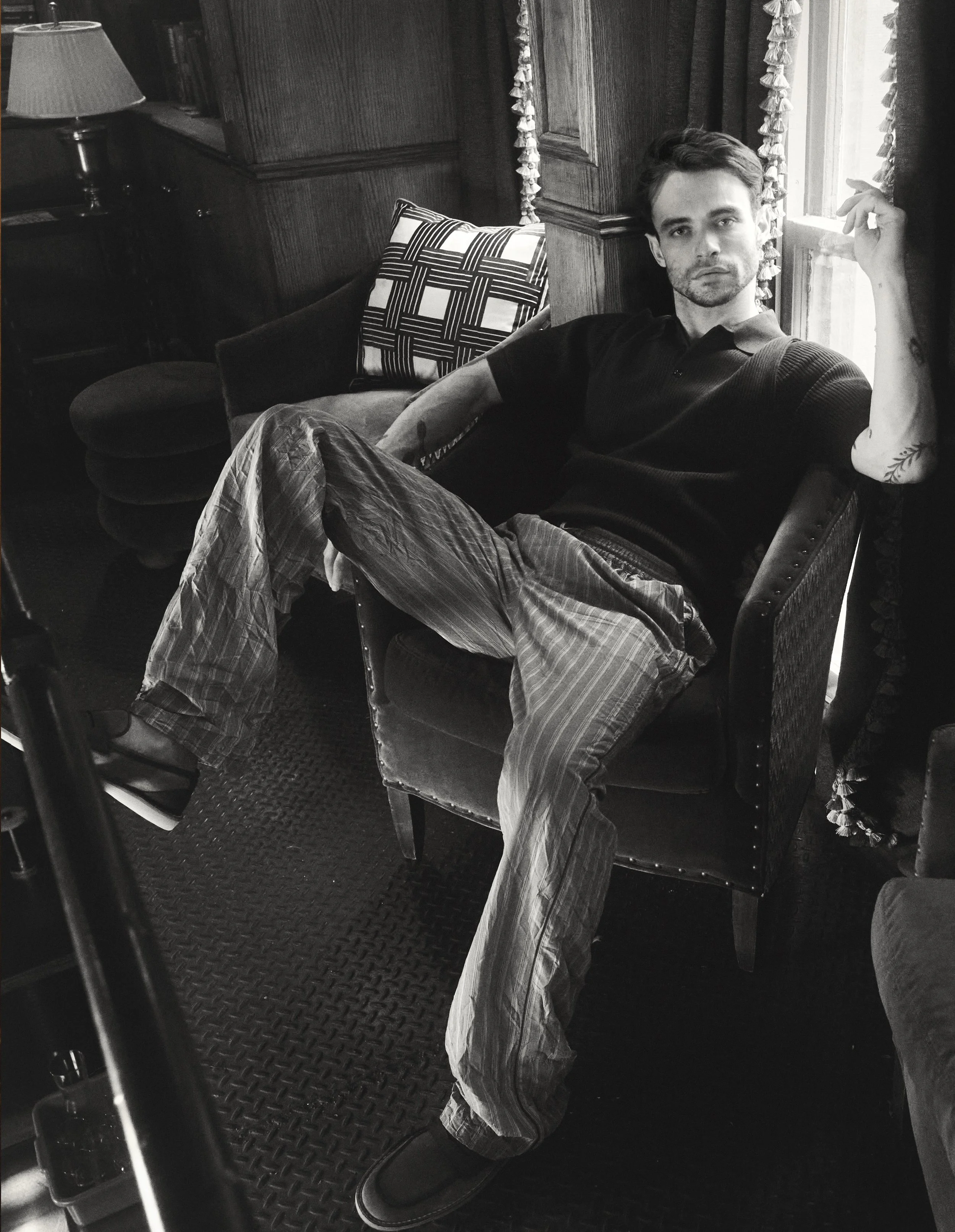
Total look DOLCE GABBANA.
“ DOING A POST-APOCALYPTIC SHOW GETS INTENSE. INTELLECTUALLY YOU KNOW IT’S FICTION, BUT YOUR NERVOUS SYSTEM DOESN’T.”
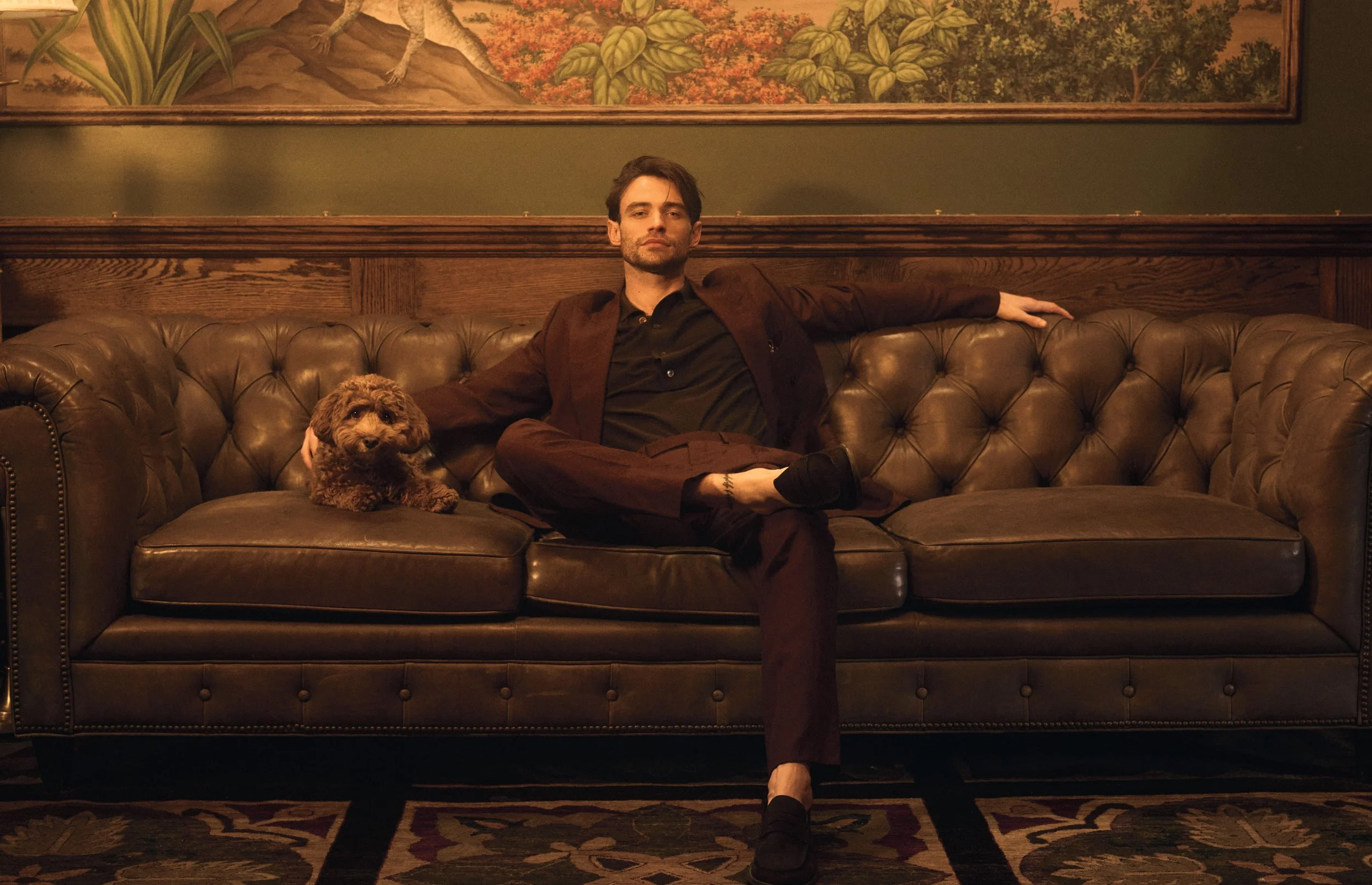
PHOTOGRAPHY KEVIN SINCLAIR STYLING CHARLIE WARD
INTERVIEW DAVID GARGIULO DOCUMENTED AT MAXWELL SOCIAL TRIBECA.
Total look BRIONI, shoes SANTONI.
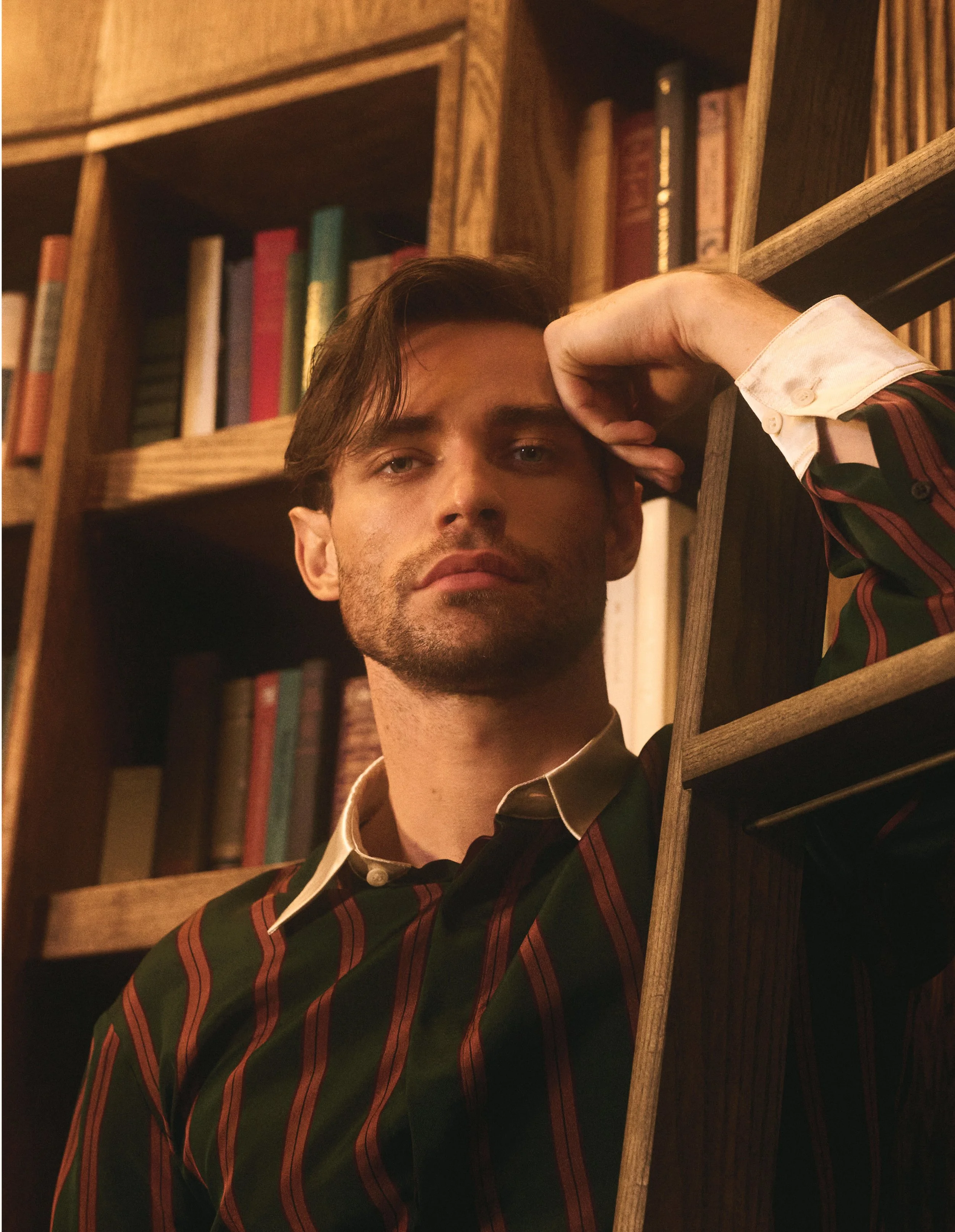
Shirt DRIES VAN NOTEN.
David Gargiulo __ You grew up in Edinburgh; do you feel that background influences the way you approach your work?
Thomas Doherty __ Definitely. I feel really grateful for the culture I was brought up in. I think it lends itself nicely to acting. There’s something about Scots; you have the weather, the clouds, the heaviness, and the history. My high school, for example, is three times older than America. You grow up with that weight and that perspective. Then there’s the tall poppy syndrome.
DG __ The tall poppy syndrome?
TD __ It’s common in Australia, Ireland, and Scotland. Basically, if you’re a poppy in a field, you don’t want to be the tallest one because the farmer will cut you down. There’s this attitude back home of “stay in your lane, don’t stand out too much.” I was definitely too ambitious, so acting was a natural fit. That kind of emotional restraint actually works really well on camera because the best acting is never just about saying the line, you always have subtext. I think Scottish people have a lot of subtext. It’s both negative and positive. But we’re also incredibly passionate, and if that’s channeled correctly, it can be formidable.
DG __ Sounds like a positive in that it makes you look for subtext.
TD __ But the flip side is overthinking. Acting is called acting, not overthinking. Moving out to America was amazing. I’ve really had to get back into my body, and it’s a constant practice to balance both.
DG __ We’re glad you didn’t stay in your lane. You bloomed in America. About your accent, you still have a bit of a Scottish lilt, but I worked with a Scottish boss in the past and needed subtitles! [laughs]
TD __ [laughs] I hear you! After the first couple of years in America, I got fed up with everyone commenting on my accent, so I softened it. Now it’s much more American-friendly.
DG __ Is there something about performing that still surprises you, even after years of doing it?
TD __ What still surprises me is my love for it. It keeps growing and becoming purer. For the first ten years, you’re figuring out your place in the industry, who you are as a person and as an actor. That’s all starting to settle for me now. So my focus has shifted more to the craft itself: working with directors, collaborating with other actors, engaging with the writers. After a decade in the industry, I’m more excited about acting than ever.
DG __ In Season 2 of Paradise, you step into the story as Link, a leader in a very harsh environment. Do you think leadership in a world like this is about strength, survival instinct, or something more psychological?
TD __ I think Link’s leadership comes from how he interacts with the world. When we first see him, there’s this ominous edge. That's survival instinct kicking in. He’s created boundaries to protect himself in a world where people are pushed to their most primitive survival state. But it’s not about a desire for power. Link doesn’t naturally want power. His motivation is more about justice. So he’s fighting back against exclusivity, the 1% who hoard power and resources. He confronts that head-on. He’s acting for the betterment of people. In the season, people will find out there are also personal reasons.
“ IT’S KIND OF WILD HOW MUCH LOVE YOU CAN FEEL FOR THIS TINY TWELVE-POUND CREATURE.”
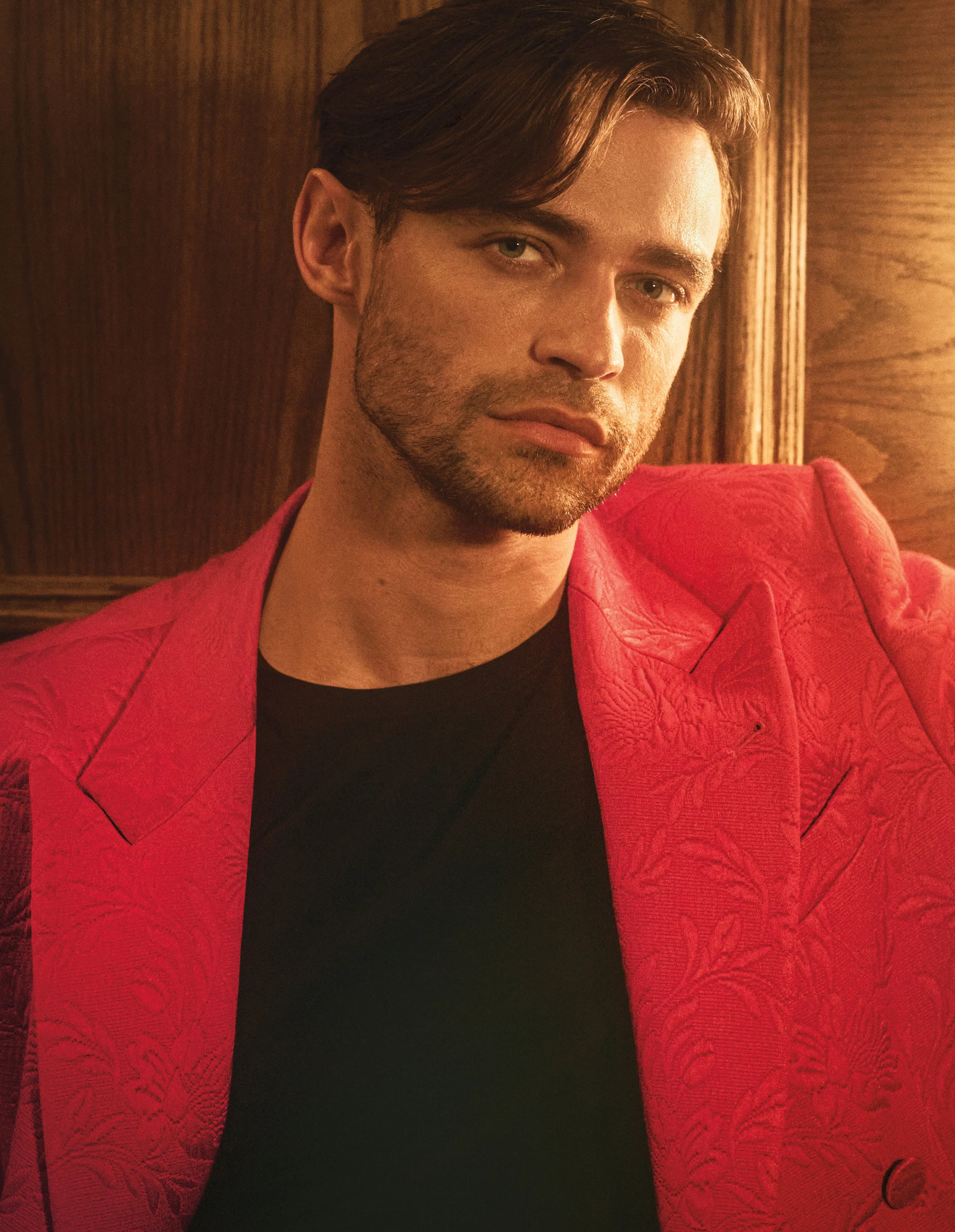
Total look DRIES VAN NOTEN.
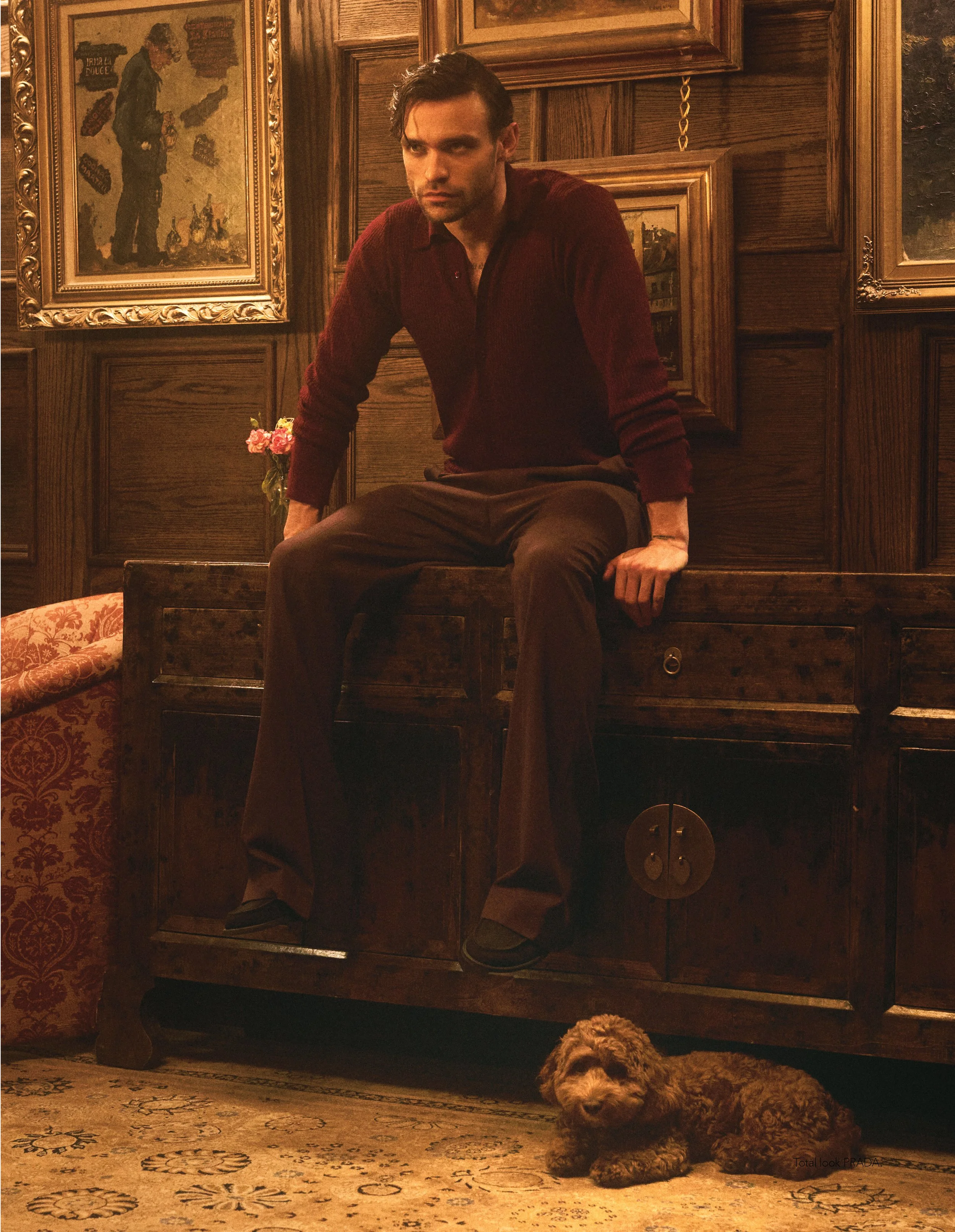
Total look EGONLAB, shoes SANTONI.
DG __ The show portrays a world transformed by an apocalyptic event. How did you transport yourself into that extreme mindset to fully inhabit Link?
TD __ I started by looking at what makes me feel safe in everyday life: walking down the street, getting groceries, ordering an Uber, everything routine we take for granted. Then I imagined a post-apocalyptic world where none of that exists. If that disappears, what’s the knock-on effect? And then the next one, and the next one. That chain reaction keeps growing, and suddenly you understand how fragile stability really is. That’s what makes the story so beautiful. Characters like Link and Xavier [portrayed by Sterling K. Brown] are living in desperate, hopeless circumstances, and yet they still choose to be good. That choice can never be taken away from them. I think about that in relation to the world right now as well, no matter what happens politically or socially, no one can take away our ability to choose. If that choice is rooted in humanity, life actually becomes simpler. You follow compassion, you follow humanity, and the path becomes clear. Watching Sterling K. Brown, seeing how he carries himself and practices what he preaches, has been incredibly inspiring on a human level. I also love the storyline with Annie [portrayed by Shailene Woodley]. Meeting Annie is a turning point for Link because it’s the first time he can let down the walls he’s built to survive. He can be himself without fear of death, without the constant need for self-preservation. The overall experience was deeply inspiring for me, both as an actor and as a person.
DG __ Link is a man who's kept himself alive through pure purpose. Do you think purpose is a substitute for hope or is it something different entirely?
TD __ I don’t think anything that happens in the human brain is ever black and white. Many motivations can exist at the same time. That’s how humans operate. In everyday life, multiple impulses are always running simultaneously; you can be deeply engaged in a conversation while also realizing you’re hungry. None of it exists in isolation. That’s what fascinates me about acting. I’ve always said that if I hadn’t become an actor, I’d probably have studied psychology, because the two go hand in hand. I’m endlessly curious about human behavior, how the mind works, how emotions evolve, how one experience leads to another. I love finding those patterns in people and in myself. So being able to explore that for a living. That’s just a gift.
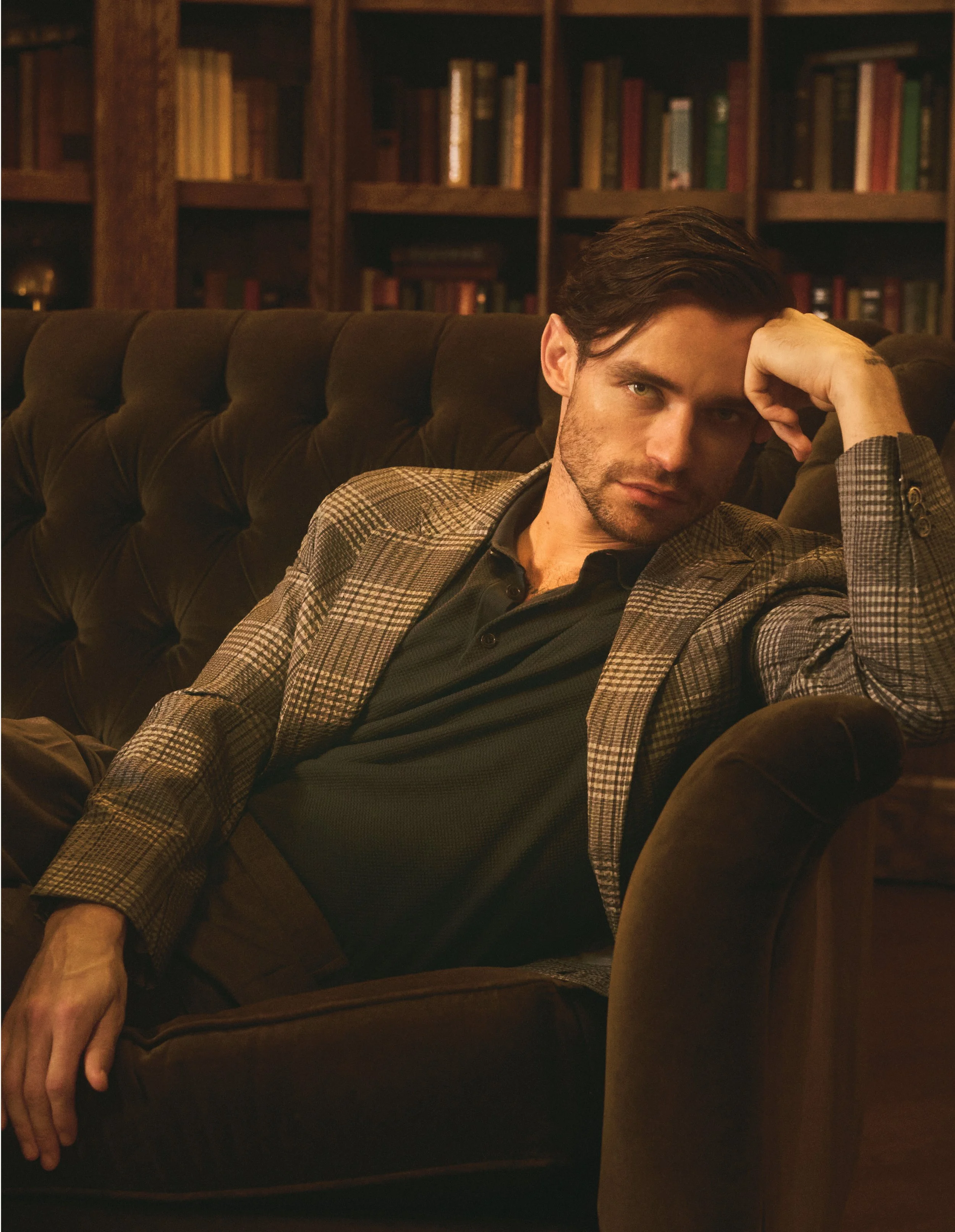
Total look BRIONI.
DG __ Remind me, is the name of your dog Daisy?
TD __ Yes! Her full name is Daisy Whiskey Doherty. [laughs, picks up, and kisses Daisy] Yeah, you're perfect.
DG __ [laughs] She is so precious. How do you think Daisy Whiskey Doherty would survive the apocalypse?
TD __ [laughs] She would thrive. She’d have the best time. I’d just be there protecting her. I’d absolutely die for her.
DG __ You’d give her your food?
TD __ [laughs and kisses Daisy] Hundred percent. It’s so crazy. I’ve had dogs and cats with girlfriends before, but this is my first time having my dog. It’s kind of wild how much love you can feel for this tiny twelve-pound creature. She’s only nine months old, still a baby. I’m excited to start taking her to work with me. Doing a post-apocalyptic show gets intense. Intellectually you know it’s fiction, but your nervous system doesn’t. If someone’s holding a gun to your head for hours while filming, your brain knows it’s an actor, but your body still experiences the stress. After a long day, it’s really grounding to come home to this little angel.
DG __ What’s something Daisy does every day that instantly lifts your mood?
TD __ So much! [smiles] Every morning I wake up and she’s already awake, just staring at me. Sometimes I try to fall back asleep, but eventually I open my eyes, say, “Good morning,” and she jumps all over my face. From that moment on, my day’s better. Honestly, I love this dog so much! Daisy’s really given me perspective. This industry is incredibly competitive, you’re constantly putting yourself forward and thinking about your own career. Having her forces me to care for something outside of myself. She looks at me with unconditional love, no matter what kind of day I’ve had. In a strange way, she’s taught me how to be kinder to myself. That’s been really beautiful to realize. [hugs Daisy]
DG __ I love this moment [waits] OK. Enough of this! [laughs] Back to the heavy stuff. Dystopian stories often reflect anxieties about the present. You mentioned social disparity earlier, but are there other themes in Paradise that feel especially connected to the world we’re living in today?
TD __ Disparity is definitely a big one but the biggest theme is choice. That’s really what the story comes back to. We live in a world now where we’re constantly bombarded with information, things on our phones that we don’t even know whether to believe anymore. With AI, manipulated media, endless news cycles, it puts people into a kind of survival state. So even in our modern society, survival exists. Systems thrive on that disconnection. When people are confused or scared, it’s easier to divide them: “you belong here, those people are the problem.” That’s how fear multiplies. And once fear takes hold, people become easier to control and more likely to act against their better nature. I think real scarcity begins internally. A lack of self-love creates a need for external validation: status, possessions, power. And that’s when harmful behavior starts to grow. Fear creates more fear, and the cycle continues. What matters, though, is that the power of choice never disappears. My mother had a huge influence on how I think about this. When I was younger, I believed strength meant retaliation, justice, and proving dominance. But I came to understand that real strength is holding yourself to your own moral standard, regardless of what the world throws at you. The older I get, the more I believe there is a right and a wrong, and the right comes from humanity, from the heart. The danger today is that we’re increasingly disconnected from that. We live up here, in our heads, overwhelmed by noise and fear, instead of grounded in our humanity. And when you lose that connection, it becomes very easy to lose yourself. For me, the central theme is choosing humanity, even when the world feels like it’s falling apart. I saw that embodied on set too. Watching Sterling K. Brown, Julianne [Nicholson], Shailene [Woodley] hold themselves to a high standard as people was incredibly inspiring.
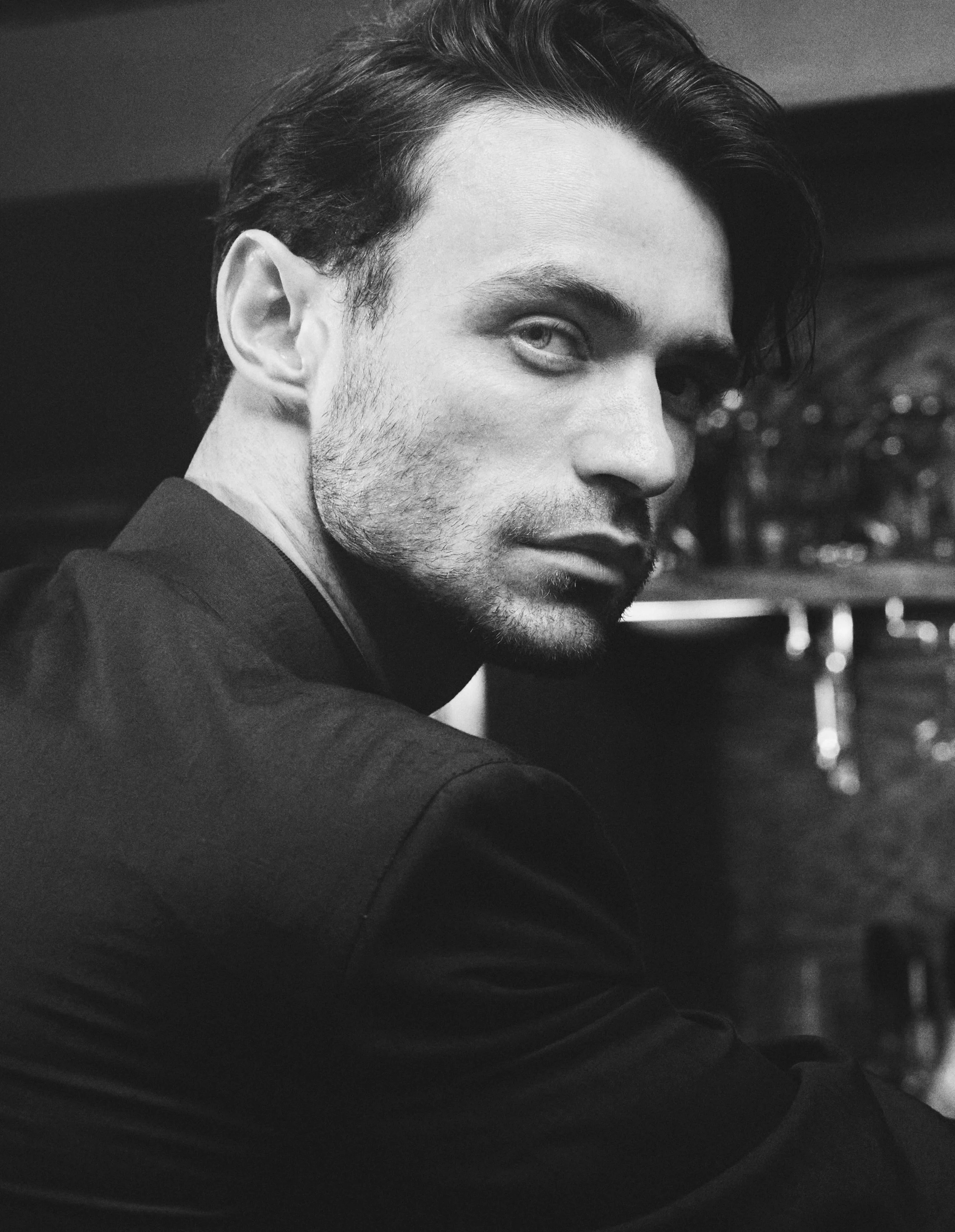
Total look BRIONI.
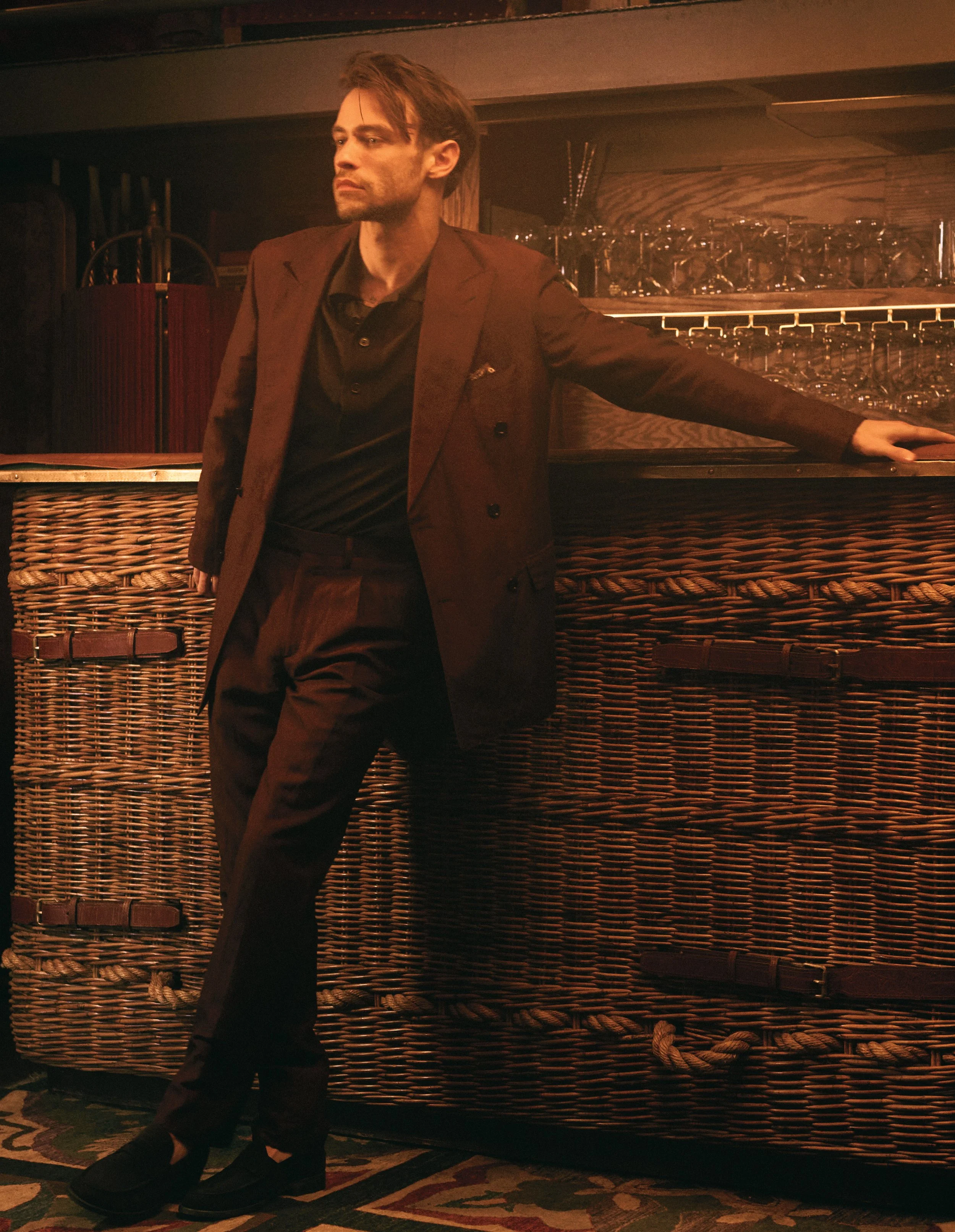
Total look BRIONI, shoes SANTONI.
“ I'VE HAD TO LEARN TO SURRENDER. ACCEPTING THAT LIFE DOESN'T REVOLVE AROUND YOU. THAT THERE'S SOMETHING BIGGER YOU'RE PART OF.”
DG __ If someone wrote a book about your life so far, what would the title be?
TD __ Interesting question. During darker periods in my life, I used to say something to myself over and over: “Keep going, wee man.” Wee man meaning my younger self. So yeah, I think that’s what I’d call it: Keep Going, Wee Man.
DG __ I love it. It shows courage and humility.
TD __ That phrase helped me through some really dark moments. It wasn’t about success or ambition. My focus is: “How can I be my truest self? How do I honor Life, God, the Universe, whatever you want to call it?” I’ve realized that the more I live in my head, the more disconnected I feel from life itself. I’m not very good at controlling everything. I’ve had to learn to surrender. [lifts his arm to reveal a tattoo that reads surrender] Accepting that life doesn’t revolve around you. That there’s something bigger you’re part of. There’s a quote often attributed to Eckhart Tolle that really resonates with me. We usually think life is the dance and we’re the dancer. But the idea is actually the opposite: life is the dancer, and you are the dance. I used to believe I had control. Now, as I get older, I realize this small ego brain can’t possibly comprehend life, let alone control it. It’s terrifying to relinquish that illusion of control, but also freeing. Because the suffering often comes from the conflict between what is and what we think life should be. I’m still figuring this out. I’m not preaching. Some days I manage a minute of genuine surrender, maybe through meditation, maybe just awareness. But that’s the practice.
DG __ You’ve talked about surrender and living in the gray. It sounds like life rarely follows a straight path, right?
TD __ Nothing in my life has ever followed a straight path. I actually have another tattoo that says “Is that so?” [shows tattoo on his finger] It comes from an old Chinese proverb. A man’s son breaks his leg, and everyone says it’s terrible. The father replies, “Is that so?” Later, soldiers come to recruit young men for war, but the son is spared because of the injury. Suddenly it’s good fortune. Again the father says, “Is that so?” The lesson is that events aren’t inherently good or bad. We only understand their meaning over time. Just to be clear, I don’t believe in toxic positivity. If I lose a role I really wanted, I’ll be devastated. I let myself feel that. But I can also recognize what I learned from the experience. Both things can exist at once. I used to see life as very black and white. Now I’m trying to live more comfortably in the gray: to accept that meaning comes less from the mind and more from here. [gestures to heart] There’s a song by Baz Luhrmann, Everybody’s Free (To Wear Sunscreen). There’s a line: “Don’t waste your time on jealousy; sometimes you’re ahead, sometimes you’re behind, the race is long, and in the end, it’s only with yourself.” That really stayed with me.
DG __ Thank you for sharing your wisdom and stories with us today. After listening to you, it's clear that real strength comes from purpose, curiosity, and kindness. Keep Going, Wee Man!
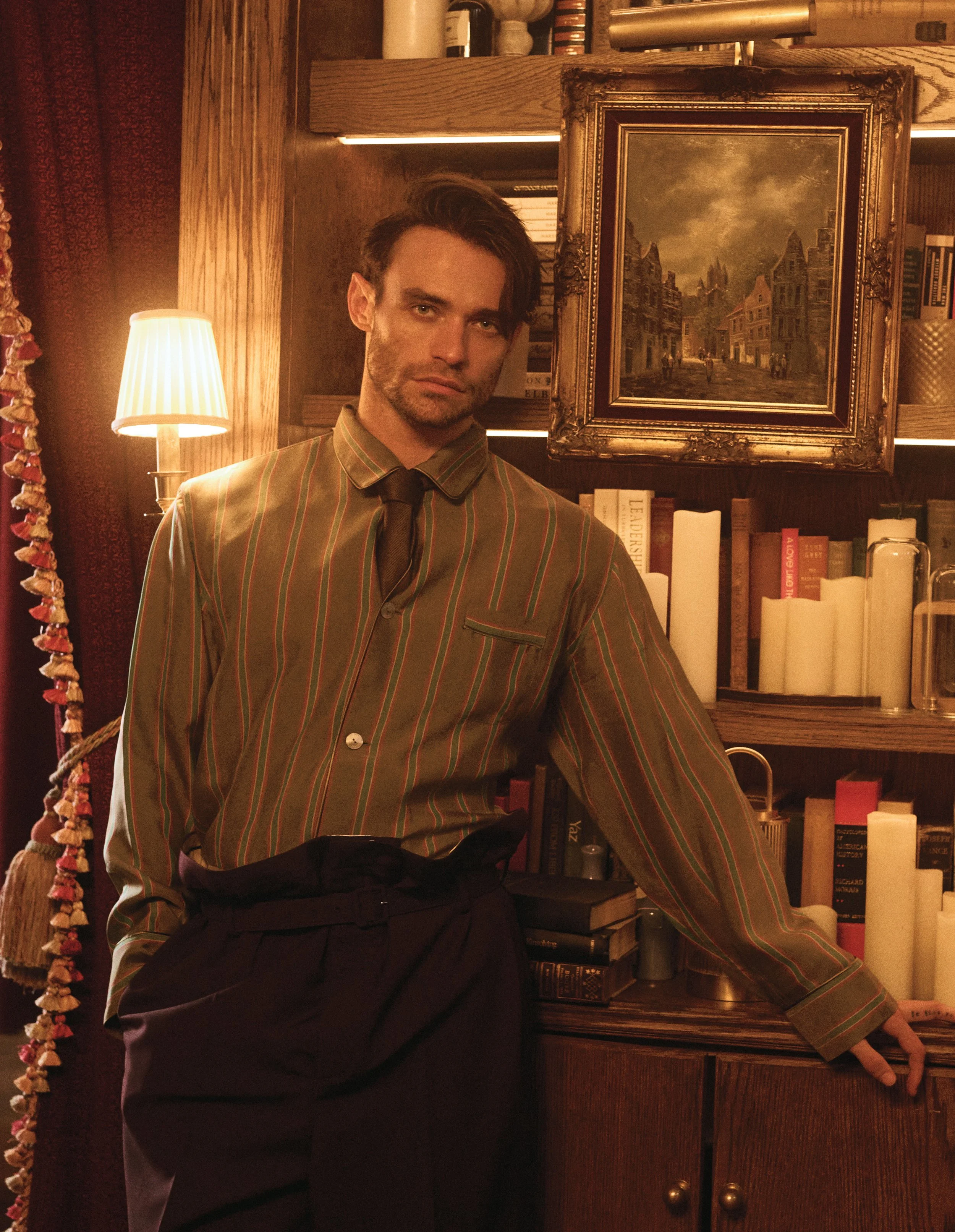
Total look SAINT LAURENT.
Creative Director Kevin Sinclair, Stylist Charlie Ward (See Management), Interview David Gargiulo, Grooming Ryann Carter (Opus Beauty) using Kevin Murphy products, Talent Thomas Doherty (The Lede Company), Photo Assistant Isaac Poole, Location Maxwell Social Tribeca.
