

AUG 17, 2026
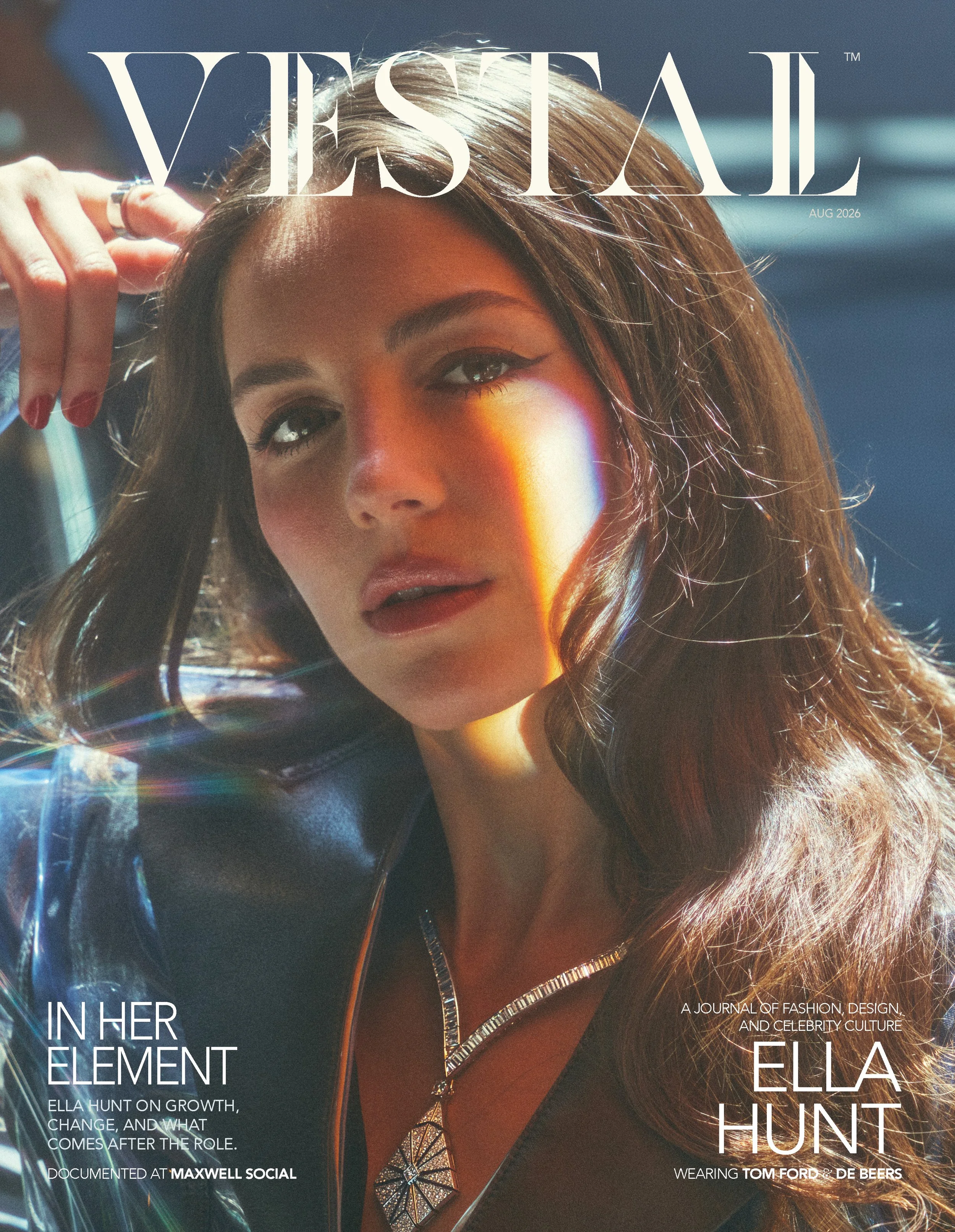
PHOTOS GUY AROCH STYLING ANNA KATSANIS INTERVIEW DAVID GARGIULO
DOCUMENTED MAXWELL SOCIAL WEARING TOM FORD AND DE BEERS LONDON.
“I THINK INSPIRATION HAPPENS TO YOU RATHER THAN SOMETHING YOU GO OUT AND FIND. I’M NOT A PERSON WHO CAN GO LOOKING FOR INSPIRATION.”
INTERVIEW WITH ELLA HUNT
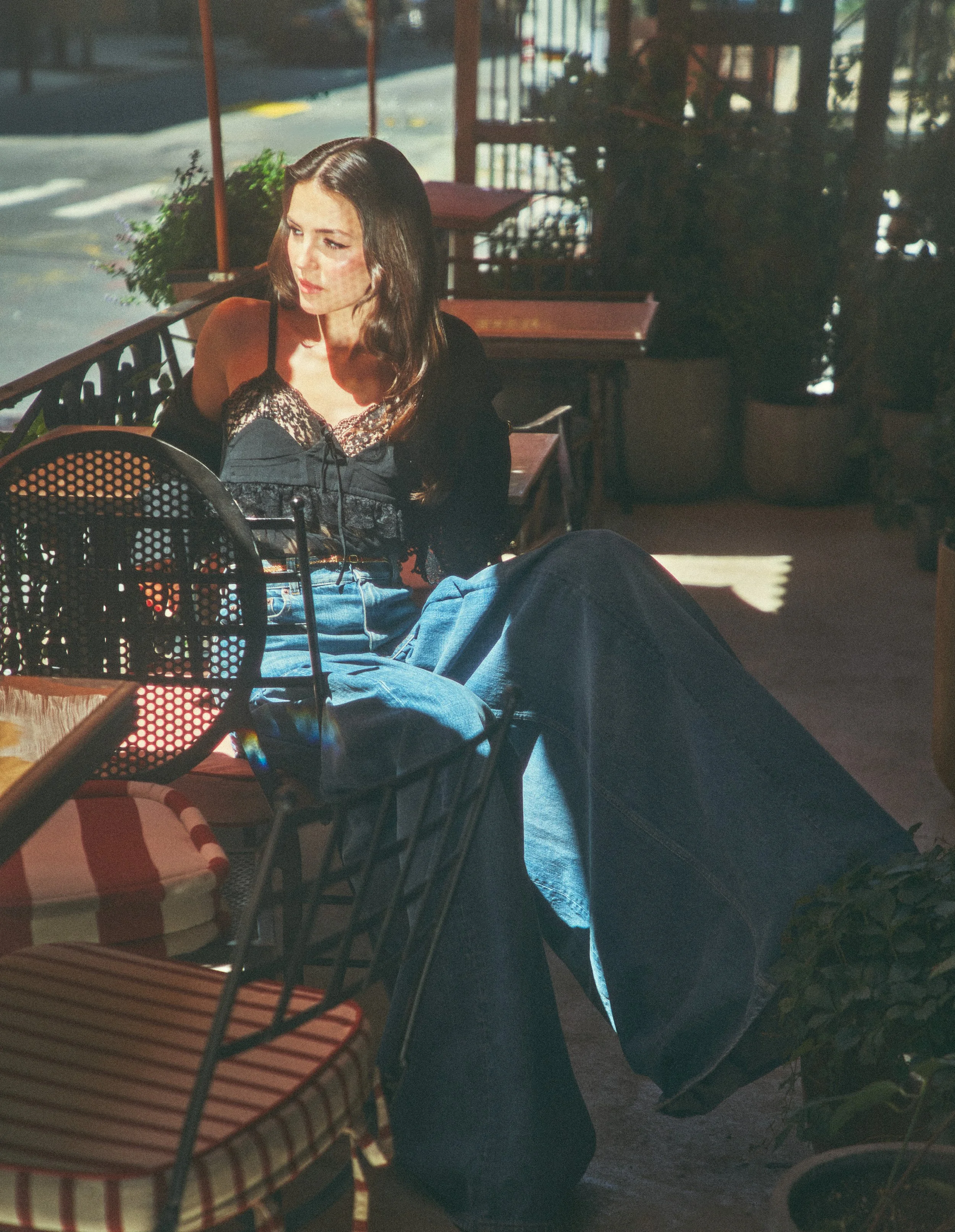
Total look CHLOÉ.
It was one of those hot summer days in Manhattan when Ella Hunt stepped into Maxwell Social in Tribeca. Inside, the venue buzzed with activity.
Staff was rearranging furniture around us, management was walking prospective clients through the space, and a podcast was being taped live in the next room. But Ella, sunny and quick to smile, and seamlessly rolling with it all, has the kind of presence that makes everything around her feel effortless. Between the bright daylight, eclectic textures, a sprawling kitchen, and a terrace sitting right on top of the city’s concrete hum, the room had felt like a mirror for the conversation Ella and I had remotely a week later: intimate, slightly unvarnished, and open to wherever things went.
At 28, Ella is currently caught between two contrasting creative milestones. On screen, she’s starring in Not Suitable for Work, Mindy Kaling and Charlie Grandy’s new comedy series, playing AJ, a fiercely driven young woman navigating the messy realities of modern ambition. Off-screen, she’s releasing Blindspot, her debut album, which sits on the complete opposite end of the spectrum: a raw, deeply personal body of songs written through a haze of grief, messiness, and figuring herself out in real time. Talking to her, what stands out is how easily she holds both light and weight at once, exploring how a comedy set and a vulnerable record actually point toward the same thing: the uncomfortable, ongoing process of just growing up.
For Ella, that process hasn't been a straight line, but she’s meeting it with a smile. It involved taking on roles that initially terrified her, like convincing herself she was totally wrong to play comedy icon Gilda Radner, and leaning into emotions she used to keep off-camera. Her current chapter isn't some polished PR pivot or a calculated rebrand. It’s just a person who loves what she does, shedding the armor, and having a genuinely great time showing up as she is.
David Gargiulo __ We spent the day together at Maxwell Social for this shoot. Was there a moment from the shoot that stayed with you?
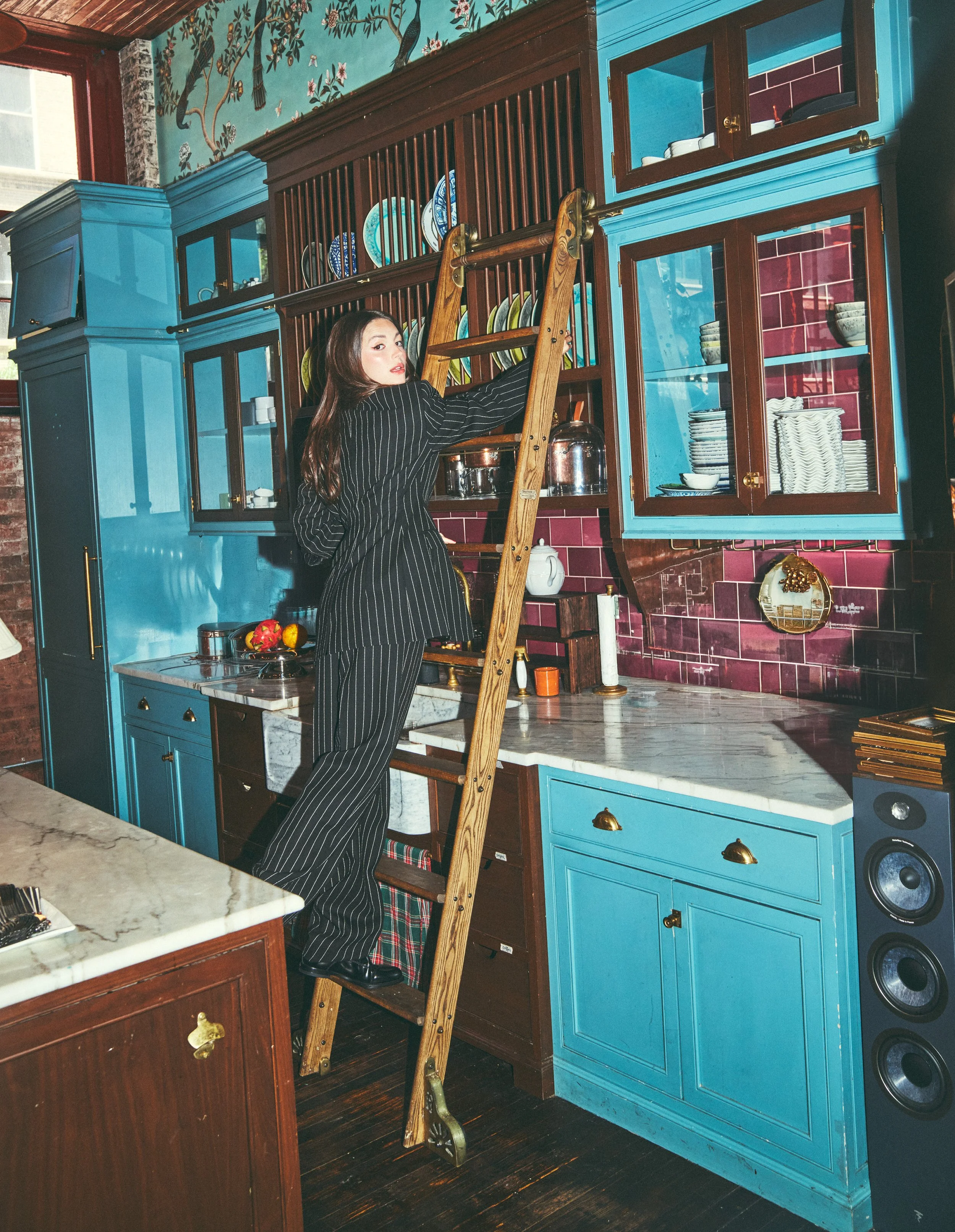
Total look DOLCE & GABBANA.
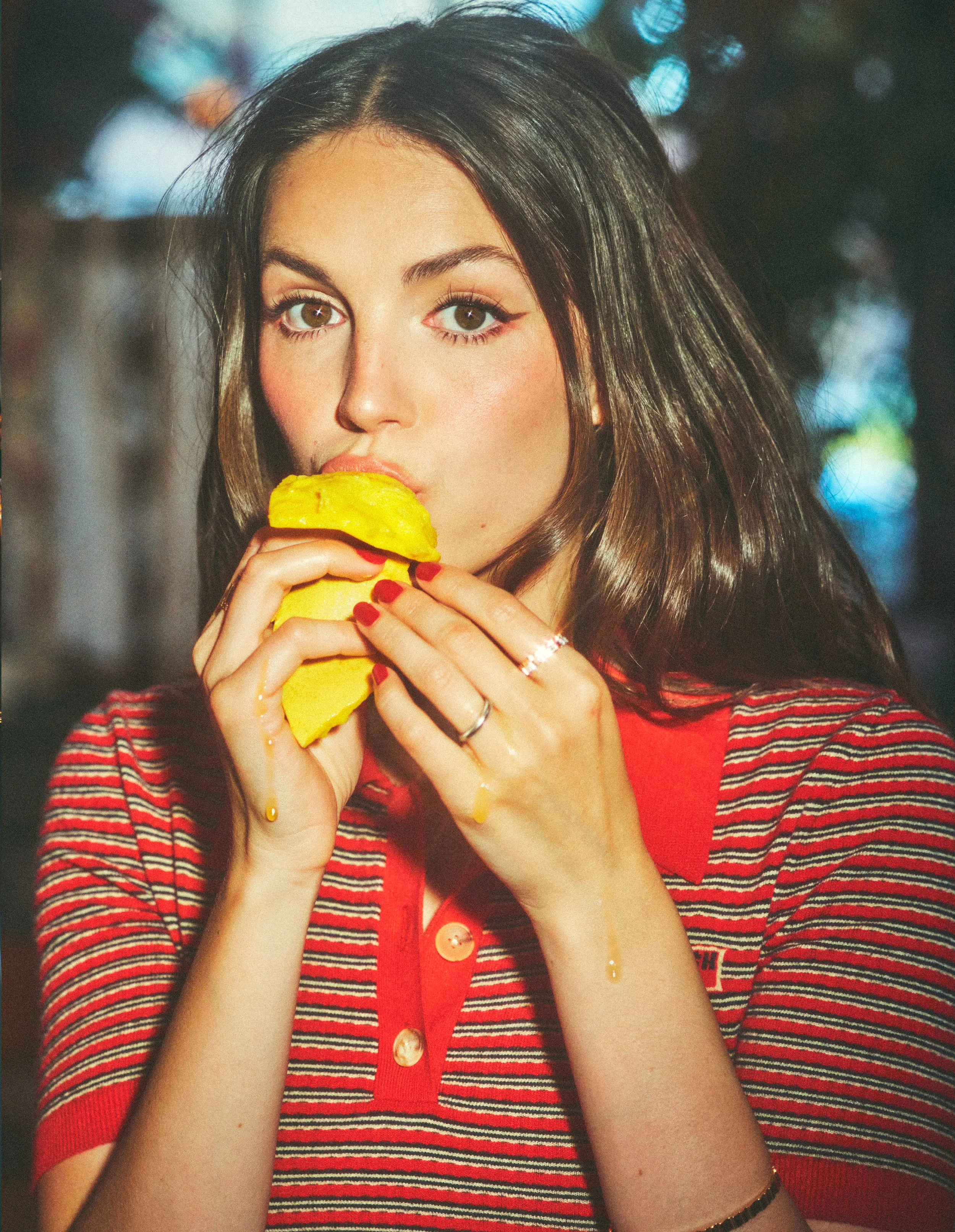
Total look TORY BURCH, jewelry DE BEERS LONDON.
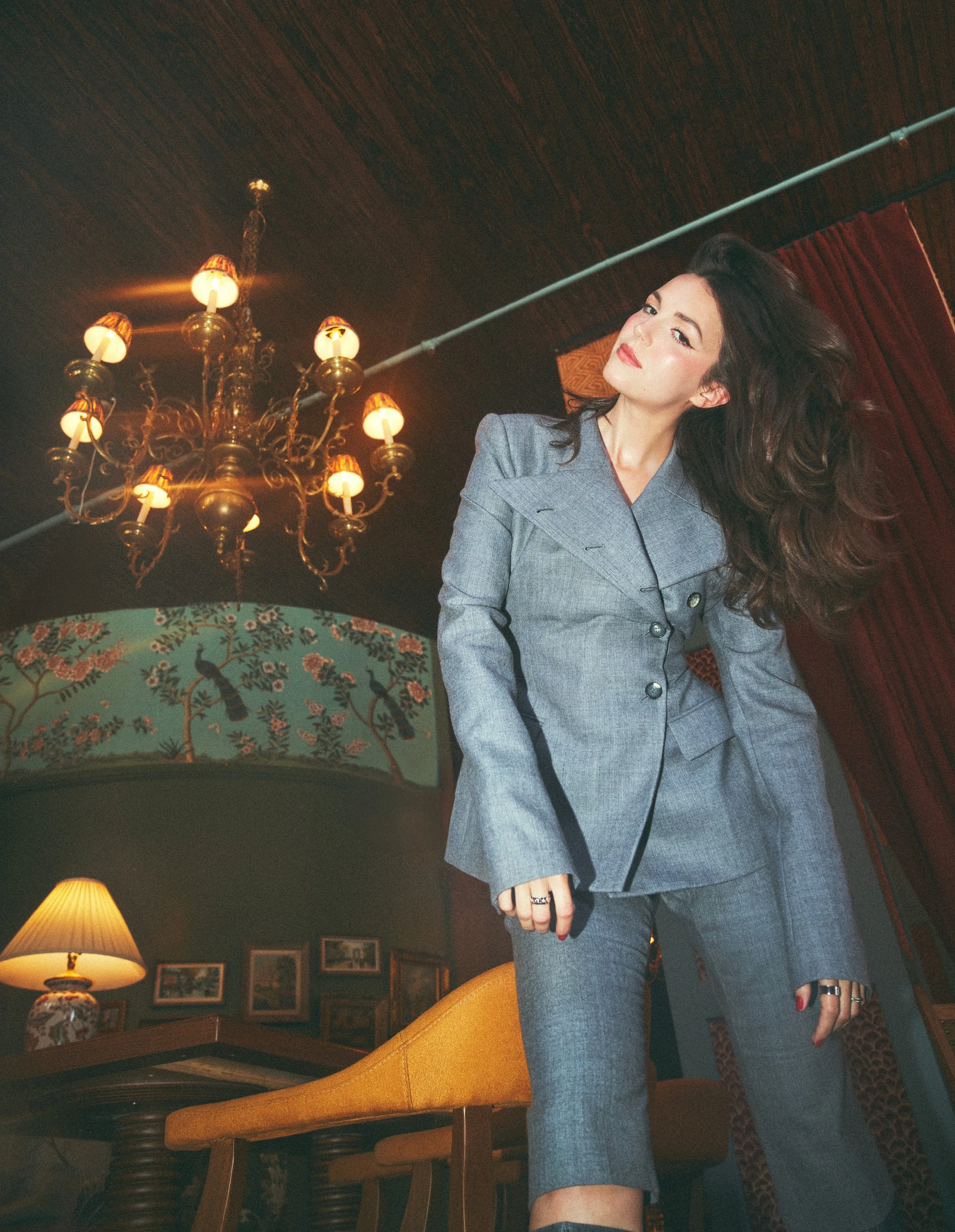
Total look MCQUEEN, jewelry DE BEERS LONDON.
Ella Hunt __ I love Guy, the photographer of the shoot. I’ve been an admirer of his work for a while, and it was really fun to see him in action. There was a moment when we went out onto the street; I think I was in a Tom Ford suit, and he wanted me to be carrying some kind of prop. It was really hot that day, and somebody just passed me a portable fan that I walked down the street with. Guy incorporated it into the photograph. He’s just one of those photographers who’s really up for throwing paint at the wall and seeing what sticks. There’s a fun looseness to his style of shooting that I really love.
DG __ Did you have a favorite look or image from the shoot?
EH __ I really enjoyed how much suiting there was in the shoot. I enjoy oscillating between androgyny and femininity in my personal style, and there was a lot of great tailoring. The image that was probably my favorite to take was the one where I was eating the mango because it was objectively a delicious mango. I was wearing Tory Burch for that one. Oh, also the Tom Ford suit with the plastic perspex overlay was so major.
DG __ Is there a belief you had in your early 20s that you’ve completely let go of?
EH __ What have I let go of with growth and time? I think in my early 20s and late teens, I had a very prescriptive idea of what I wanted my career and personal life to look like. A lot of the goals and milestones I set for myself were great motivators, but I think they also distracted me from enjoying the present. As I’ve gotten further into my 20s, I’m much more appreciative of surprises. The relationships I couldn’t have predicted and the roles I wouldn’t have written for myself that ended up becoming some of the most fulfilling parts of my career and personal life so far. I’m trying to just be down for the ride now.
DG __ Do you have any examples of those roles or moments?
EH __ So many. I played Gilda Radner in Saturday Night, the film about the original cast of Saturday Night Live, and I remember when that audition came through, I sent my team a message saying, “I definitely should not do this. I’m definitely the wrong person to play Gilda Radner. I could never do it. I’m not funny enough. I’m not American enough.” There was so much about it that made me feel like the wrong person, and I ended up loving it. I really loved it and learned so much. I think you learn from putting yourself in situations you aren’t familiar with, situations that make you expand. Gilda is a really good example of a moment in my 20s where I had an expectation for myself and was surprised by a completely different outcome.
DG __ You mentioned learning from that experience. Beyond putting yourself out there, what was the biggest lesson you took from playing Gilda?
EH __ I’d previously had a lot of opportunities to play very quiet, stoic, thoughtful people on screen, but I’d had very few opportunities to be joyful and large. Everything I had done before that was quite small, and I’d be lying if I didn’t say that was a real comfort zone for me. I really enjoy playing these muted, pensive characters. But it was such a fun discovery to play someone so vivacious and to learn how to approach American comedic timing. Coming to the States as a Brit and living in New York, I had such admiration and reverence for the cast of Saturday Night Live and people like Kristen Wiig and Maya Rudolph. I didn’t think I could do what they did, and I still by no means think I’m an SNL-worthy comic. But playing Gilda gave me real access to that kind of comedy. I spent so many hours watching Gilda and that season of Saturday Night Live, and I had the opportunity to learn so much from it. I don’t think I would have done Not Suitable for Work and played AJ if it wasn’t for the school of Gilda Radner.
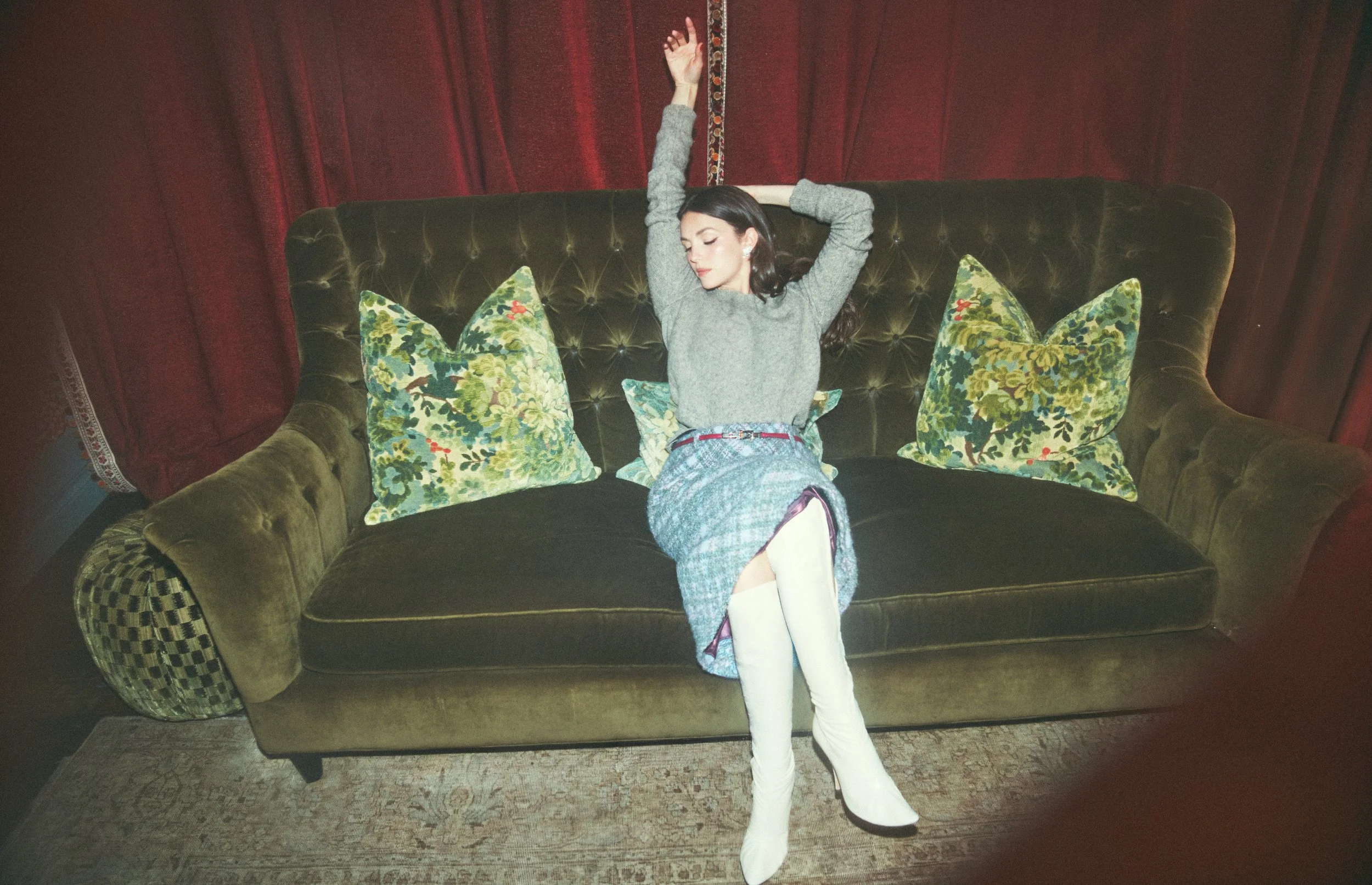
Total look MARC JACOBS, jewelry DE BEERS LONDON.
“WHEN I WAS WRITING THE SONGS, THEY REALLY FELT LIKE SIBLINGS TO ME. THEY HAD A CHRONOLOGY, AND THEY FELT LIKE THEY WERE READY TO STAND TOGETHER IN A FAMILY PORTRAIT.”
— ELLA HUNT ON BLINDSPOT
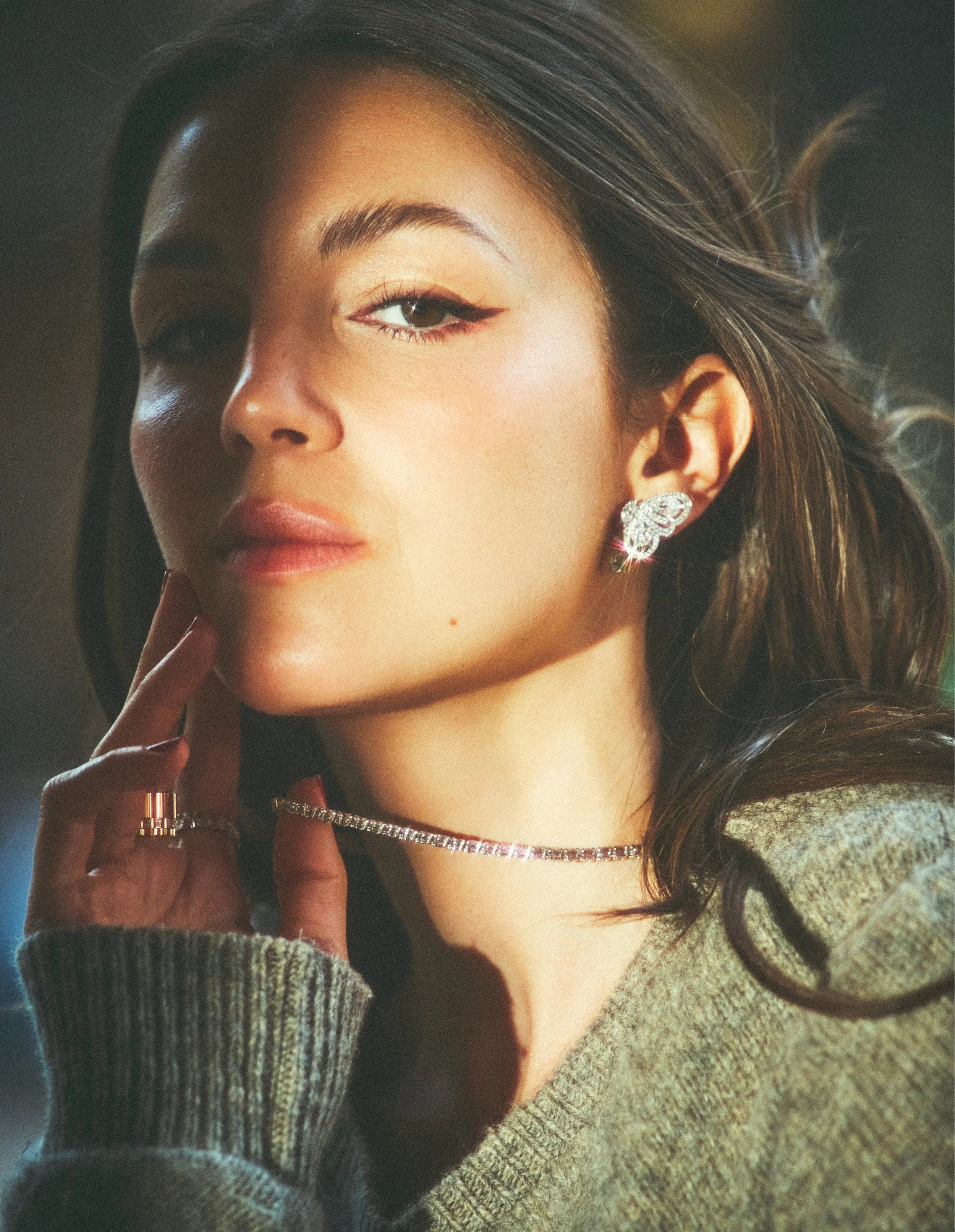
Sweater MARC JACOBS, jewelry DE BEERS LONDON.
DG __ For AJ in Not Suitable for Work. You already had the experience with comedy, so you were probably feeling more comfortable with that. When you first read the script and met AJ as a character, what made you think, “I know this person”?
EH __ I think what is such a treat about playing AJ is that she’s incredibly passionate. She’s obsessed with and devoted to her job in a way that can sometimes be a little one-track-minded, and even slightly off-putting. It’s rare that we see a woman on screen who is so obsessed with making money, making deals, and achieving professionally. Her drive is somewhat goofy, but I think what really drew me to AJ was how passionate she is. I hadn’t had the opportunity to play someone so devoted to their profession before. I think that’s what’s unique about the show as a whole. Mindy has created a show about a group of young people who are characterized by their passion and ambition. We see a lot of this generation depicted on screen as disinterested, complaining, unsure of what they’re doing, or not really activated in their professional lives. I don’t think that’s the case for a lot of us, and it certainly isn’t the case for a lot of us New Yorkers. It just doesn’t make sense. Late-stage capitalism means we all have to go to work. So it was really fun to make a show about a group of people who are genuinely obsessed with their work.
DG __ We all have different versions of ourselves that we bring to work, our relationships, and our private lives. Did playing AJ make you reflect on the different masks we all wear?
EH __ I think I’ve been reflecting on masking in personal life and the workplace quite a lot recently, and it’s actually something that, as much as it’s a topic in Not Suitable for Work, is also a theme I’m interested in as a musician. As someone who wears multiple hats, as an actress and a musician, that kind of shape-shifting or masking is really fascinating to me. When it comes to playing AJ, part of the delight of the character is how different she is in her friendships and personal life compared to who she is at work. It’s surprising what an awkward duck she is at home considering how self-possessed and brilliant she is in the workplace. But I also think there’s a mask she’s required to wear professionally, as a woman and as someone from a working-class background, that maybe isn’t a complete representation of who she is at her core. I definitely resonate with that. I think I’ve felt, at different stages in my creative and professional life, that I needed to present myself or behave in a certain way to achieve people’s approval. As I’ve gotten older and gone through grief, I feel like I’ve been able to let go of some of that masking, because it’s such a waste of time.
DG __ Comedy has a way of revealing uncomfortable truths. What do you think Not Suitable for Work is really saying beneath the humor?
EH __ Oh, golly. I think Mindy Kaling and Charlie Grandy would probably have a better, more eloquent answer to this than I would. But for me, I think the core truth of the show is that your 20s are really about realizing your friendships are the most important thing. Regardless of how brutal, funny, or strange your workplace experiences might be, the experience of sharing them with your friends and retelling those stories ends up becoming more important than the individual moments themselves. I’d say the thing I’m most proud of taking from my 20s is my friendships.
“THE CORE TRUTH OF THE SHOW IS THAT YOUR 20S ARE REALLY ABOUT REALIZING YOUR FRIENDSHIPS ARE THE MOST IMPORTANT THING.”
— ELLA HUNT ON NOT SUITABLE FOR WORK
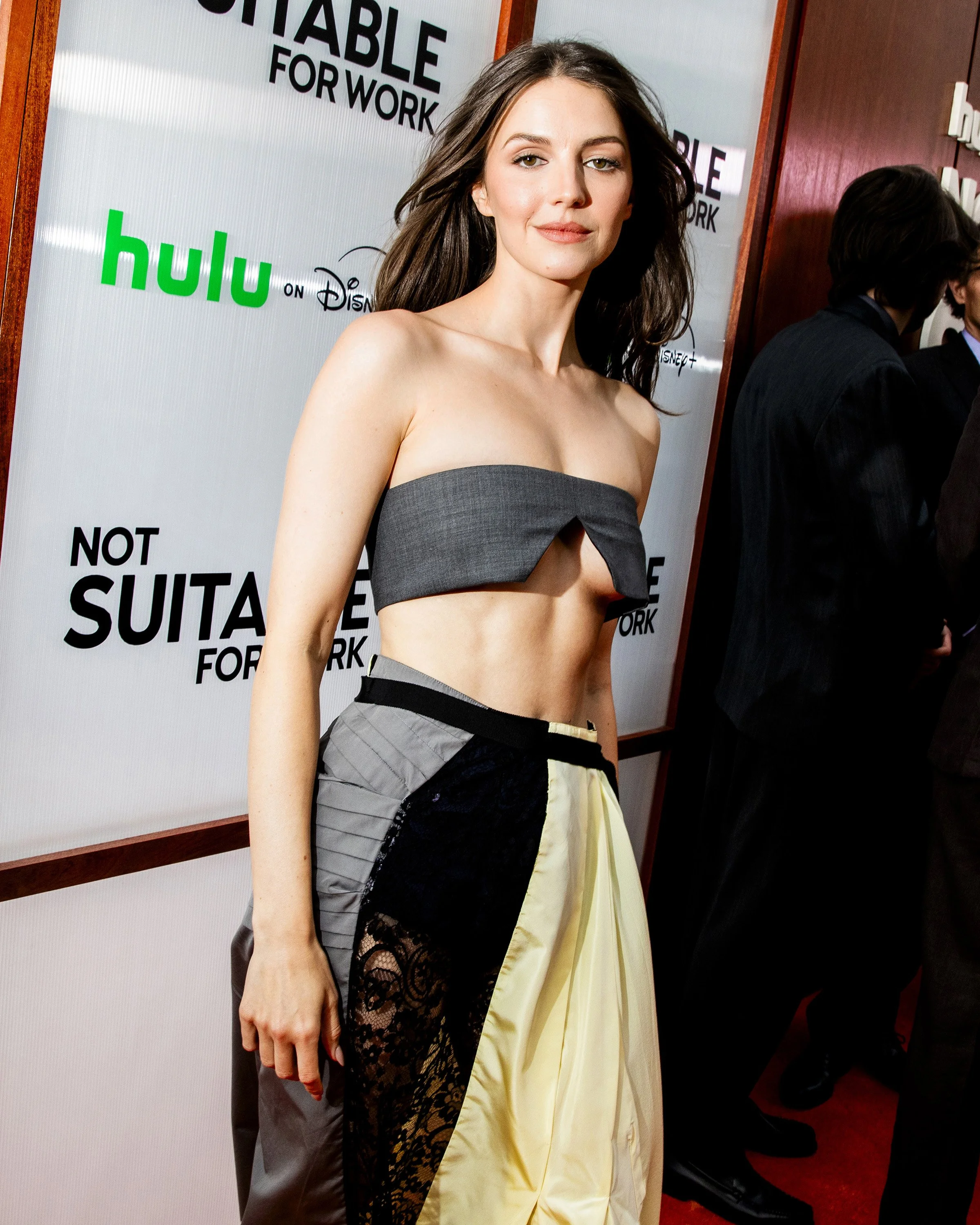
Courtesy of Hulu + Disney+
DG __ Which is actually a big theme in the show.
EH __ Yeah. Friendship is really at the heart of the show.
DG __ Let’s go into your music. Your album Blindspot suggests the parts of ourselves that we don’t always recognize or understand. That’s how I interpreted the title when I heard the song.
EH __ I love that interpretation. I think what I like about the title is that there are so many different ways to interpret a blindspot and the idea of having one. But I love that reading of it.
DG __ What did making this album reveal to you about yourself?
EH __ Oh, golly. So much that it’s hard to pin down one thing.
DG __ Let’s go one layer at a time, like an onion.
EH __ OK. Let’s peel back the layers of the onion. [laughs] I guess the first layer was that I had been fantasizing about making a full-length album for a decade. To discover myself writing a body of work for the first time, and to experience the difference between writing something that feels like a complete body of work versus a collection of singular ideas, was such a thrill. When I was writing the songs, they really felt like siblings to me. They had a chronology, and they felt like they were ready to stand together in a family portrait. That was a great lesson in understanding what it should feel like to write an album. The next layer is that the album is largely inspired by grief. My half-sister Emily passed away from brain cancer in June 2023, and initially I really didn’t want to write about grief. I didn’t like the idea of turning what was a very real and challenging experience into my own personal poetry project, or trying to tie a neat bow around something as complicated as grief. Grief exists on such a wide spectrum of emotions, and it takes a really long time. But I’d say the album really is me processing grief in real time. There are so many lessons woven throughout the entire record. And then another layer is that I had always written music alone at a piano, and I thought that was the only way I could make music because my timing has a lot of rubato in my playing. It’s essentially an ebb and flow in timing. It’s not locked into a fixed time signature. As I got further into making the record, I did a residency at Café Carlyle, this incredible historic venue in New York City. The fee they paid me allowed me to ask some of the musicians I love in New York to play with me. I played with a band for the first time, and I loved it so much. It reminded me of the way I felt going to concerts as a kid. I think I had forgotten how much of a dream it was for me to be the frontwoman of a band. The album ended up becoming much more of a band record than I anticipated, and I think going forward the sound will be much more collective rather than just me at the piano.
DG __ The stage is intoxicating, isn’t it?
EH __ It really is. I had known that before playing with a band. I love playing solo, just me and the piano on stage, but there’s something about the collaboration and craftsmanship, and the way a song can expand and exhale when you’re playing it with a group of people, that was really fun for me to discover. I can’t believe it’s taken me until the ripe age of 28 to work this out. God, girl, I wish I could go back and tell 17-year-old me to just join a band! [laughs]
DG __ Do you want to be in a band long term?
EH __ Definitely. Long term, I want to be playing shows with my band. Music, film, and television are the things I want to do my whole life, and I just want to keep getting better at all of them. One of the most joyful things about making music is playing with other people. So yes, that’s definitely what I want to do long term.
“I’VE BEEN ABLE TO LET GO OF SOME OF THAT MASKING, BECAUSE IT’S SUCH A WASTE OF TIME.”
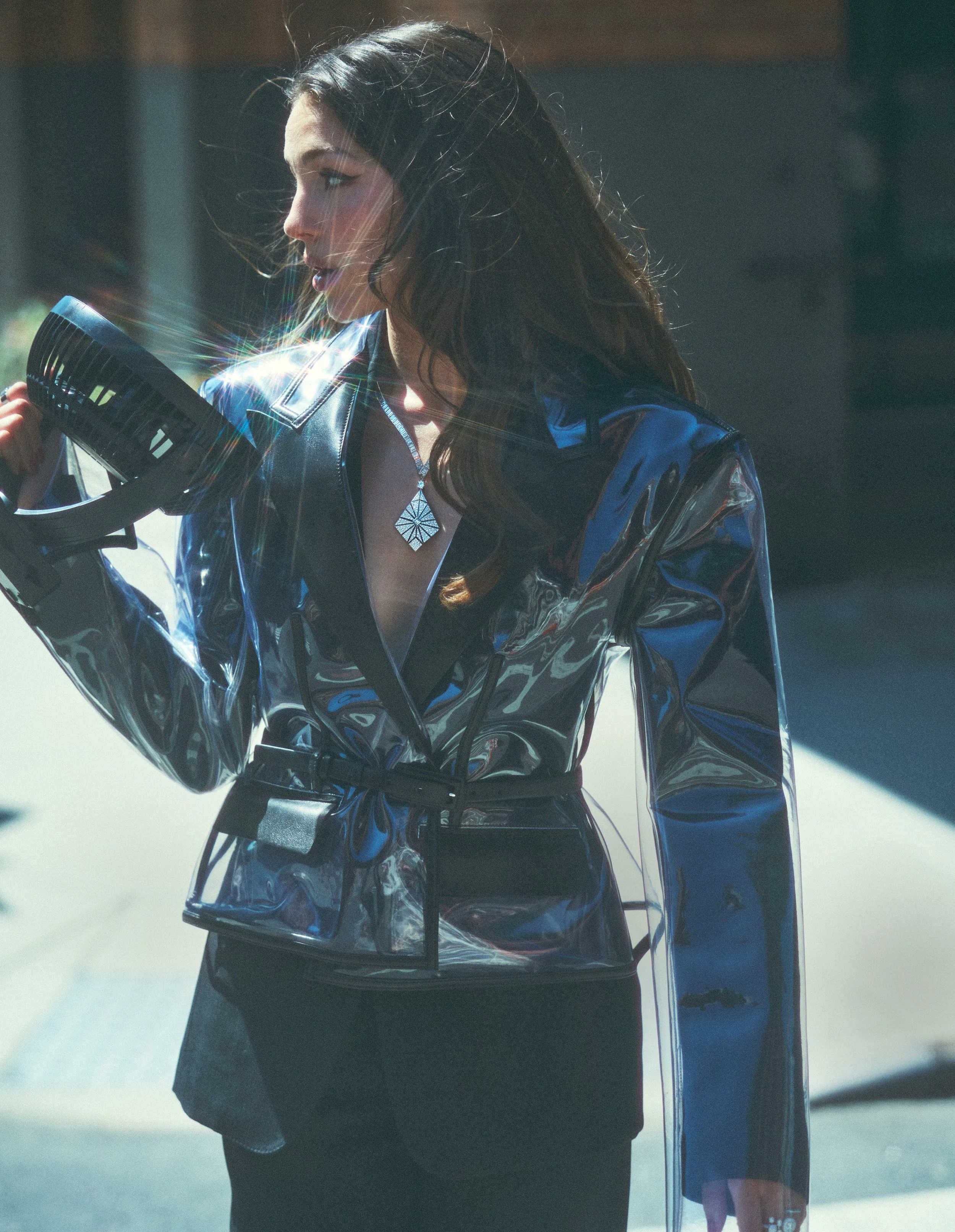
Total look TOM FORD, jewelry DE BEERS LONDON.
DG __ Were there moments when sharing the songs on Blindspot felt more intimidating than stepping onto a film set?
EH __ Yeah, absolutely. But the intimidation is very different because it’s a personal intimidation versus an external one. It’s a funny experience to feel intimidated by what might come out of your own mouth. That was a big part of why I didn’t start writing about grief right away. What’s so pleasurable about songwriting is the risk and reward of that intimidation. Something begins as this thing that feels daunting, uncomfortable, and scary; where you’re asking yourself, “Am I the right person to be writing about this? Do I have the life experience, the knowledge, the words?” And then the reward of eventually doing it and creating something you love makes that initial fear feel worthwhile. I do think, more and more as I get older, that being an actor and a musician are both such thrill-seeking professions. I think about this a lot with acting. The terror I feel before meeting a new director, going on stage, or walking onto the first day of a film shoot. I always think, “Why would I put myself through this?” Every time I get to one of those moments, I think, “Why am I doing this to myself?” And then I get to the end of the day and think, “I feel great. Let’s do that again.”
DG __ Talking about Not Suitable for Work again, AJ is navigating the version of herself she presents to the world, while Blindspot feels like an intimate look at the person behind that image. Was that contrast something you were consciously thinking about, or were they simply two separate creative experiences?
EH __ As a writer, my process is pretty unconscious. When I step into making something, I rarely know exactly why I’m making it. With regards to the crossover between Blindspot and Not Suitable for Work, most of Blindspot was written long before I was attached to play AJ, so I wasn’t consciously thinking about the relationship between the two things. But I really love your question and the way you’re looking at them. Something I’ve found myself really grateful for during this press run for Not Suitable for Work is that I love acting so much, and I loved playing AJ. I would happily keep playing AJ for a decade. But it’s been really rewarding to be able to show and share more of myself during this press run because I’ve had Blindspot coming out at the same time. I’ve felt able to bring more of the different parts of myself into conversations like this. Previously, I think I felt a responsibility to promote the project I was a part of and focus less on who I am as a whole person. And I think that sometimes led to a private discomfort of feeling fragmented, like, “I’m this, and I’m these other things as well. How could I possibly share all of it?” Maybe I don’t need to. Maybe it’s okay to have something that’s just mine. But it has felt really good to be able to encompass all the different areas of my artistry during this interview.
DG __ Thank you for opening up and letting us see you as the person instead of just the actor or musician.
EH __ I think it’s a tricky thing for actors and people in the public eye who are making things they have to promote. There’s a real expectation, especially with social media, that we share all of ourselves. That people might be interested in every part of who we are. But that doesn’t leave a lot for you at the end of the day. I really respect people who draw firm lines around what they share and what they don’t share about themselves. For me personally, though, I’m interested from a creative perspective in sharing and learning through these kinds of conversations. Although, I will say, sometimes when I read back interviews I’ve given, I think, “Whoa, I didn’t need to say that much.” But I think part of my artistry is a kind of openness, and I’m trying to make peace with the fact that, in some ways, that can be more exposing.
DG __ I think audiences respond to that. It creates a connection. Are you someone who finds inspiration by searching for it, or does it tend to arrive unexpectedly?
EH __ Definitely unexpectedly. Whenever I search for it, it’s like trying to find a needle in a haystack, or actually, a needle in a stack of needles. Inspiration is everywhere. How something resonates with me is a completely different question. There are so many things I’d love to write about, and then I try to write about them and realize I’m completely ill-equipped. So yes, I think it’s something that happens to you rather than something you go out and find. I’m not really a person who can go looking for inspiration.
DG __ Do you have an example of a moment when inspiration arrived unexpectedly and surprised you?
EH __ Coming back around to what we were talking about earlier, there’s a song on the record called “Subway Trash.” For me, it’s about the male gaze industrial complex and the ways that I, as a person and performer, have shape-shifted to please, intrigue, and win people over. I don’t think that was something I ever expected to have the words for, or even thought would make a good song. So that was a surprise.
