

PUBLISHED OCTOBER 5, 2026
“NOW THAT THE MOMENT HAS COME? I FEEL I’M FINALLY AT HOME IN MY OWN LIFE.”
— TAYLOR BLOOM

WEARING CELINE

PHOTOS KEVIN SINCLAIR FASHION EDITOR CHARLIE WARD
DOCUMENTED IN SOHO, NEW YORK.
PROFILE: TAYLOR BLOOM
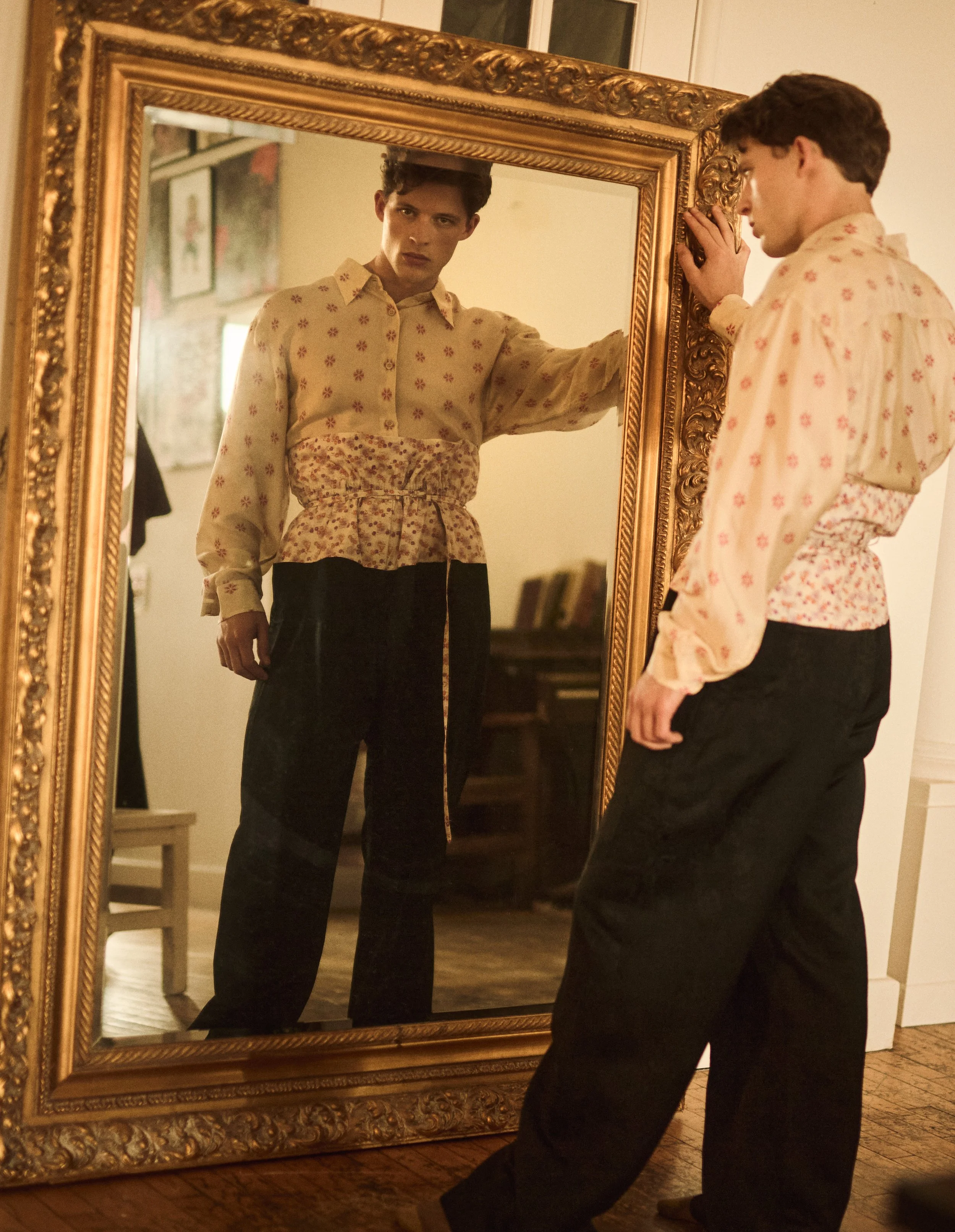
Total look DRIES VAN NOTEN.

WORDS BY ARNOLDAS ŠMITAS
Taylor Bloom is having the kind of moment actors spend years working toward. With NBC’s Line of Fire, his face is reaching a wider audience, the opportunities are getting bigger, and after nearly a decade of auditions, day jobs and persistence, something has finally shifted. Yet Bloom doesn’t speak about this moment like someone suddenly swept up in it. If anything, he sounds remarkably settled. “I’ve never been more grounded and easygoing than in these last months,” he says. “I’ve known for a long time that this is what I’m meant to be doing.”
That certainty came long before the attention. Bloom grew up in Virginia’s Shenandoah Valley, one of five brothers and a twin. In a family that large, learning how to occupy space can be its own education. “First, I learned to disappear,” he says. He remembers himself as an overactive, overweight child who felt that he would “always take up more space than I could deserve.” He watched his family closely, especially his twin brother, whose confidence seemed natural. Then, at 11, the brothers joined their first play. Suddenly the restless energy Bloom had spent trying to contain had somewhere to go. Onstage, he discovered it could be “sharpened and celebrated.”
Theater became more than an outlet. It gave Bloom a sense that there was a place where the qualities that made him feel different could become useful. “Most kids grow up feeling a little or a lot out of place,” he says. “Studying theatre gave me the feeling that there was an importance and gravity to the work I could do.” As a college freshman, he remembers approaching acting almost as if he were “learning an ancient martial art.” He laughs at some of that training now; he says he tries to forget much of what school taught him about acting, but one idea survived. “I try to remember that theatre matters and because I am a part of the theatre, I matter too.” That sense of purpose stayed with him even when acting stopped providing the immediate reassurance of an audience. What began as a place to channel his energy gradually became something more permanent: a way of understanding where he belonged and what he wanted his life to be built around.

Sweater LEMAIRE.
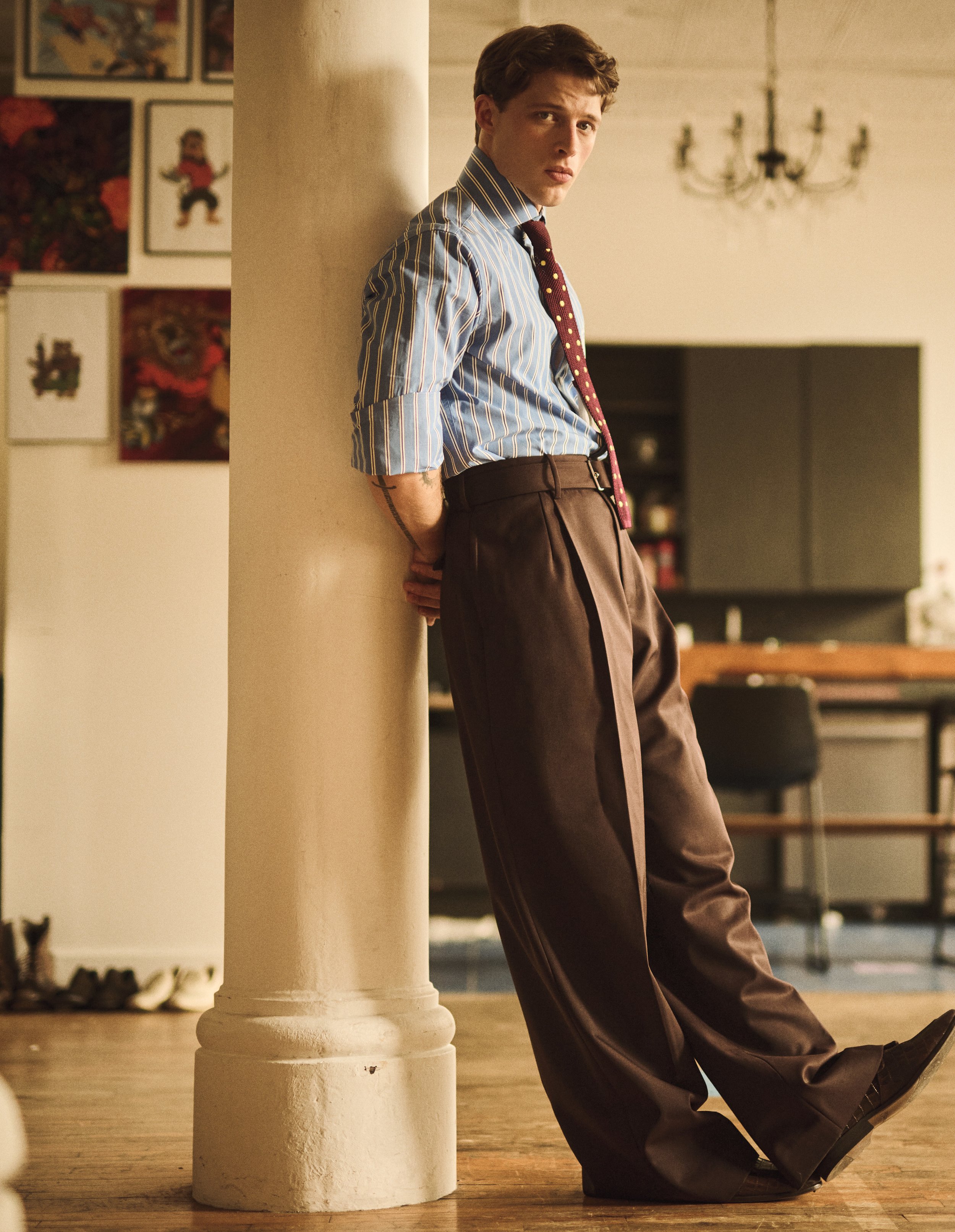
Total look MITHRIDATE, shoes SANTONI.
“ IT’S NOT NAIVETY, IT’S FAITH. IT’S HIS SUPERPOWER.”
— TAYLOR BLOOM ON RUSS HOLLINGSWORTH IN LINE OF FIRE

Line of Fire, courtesy of NBCUniversal. New episodes Mondays on NBC and streaming next day on Peacock.
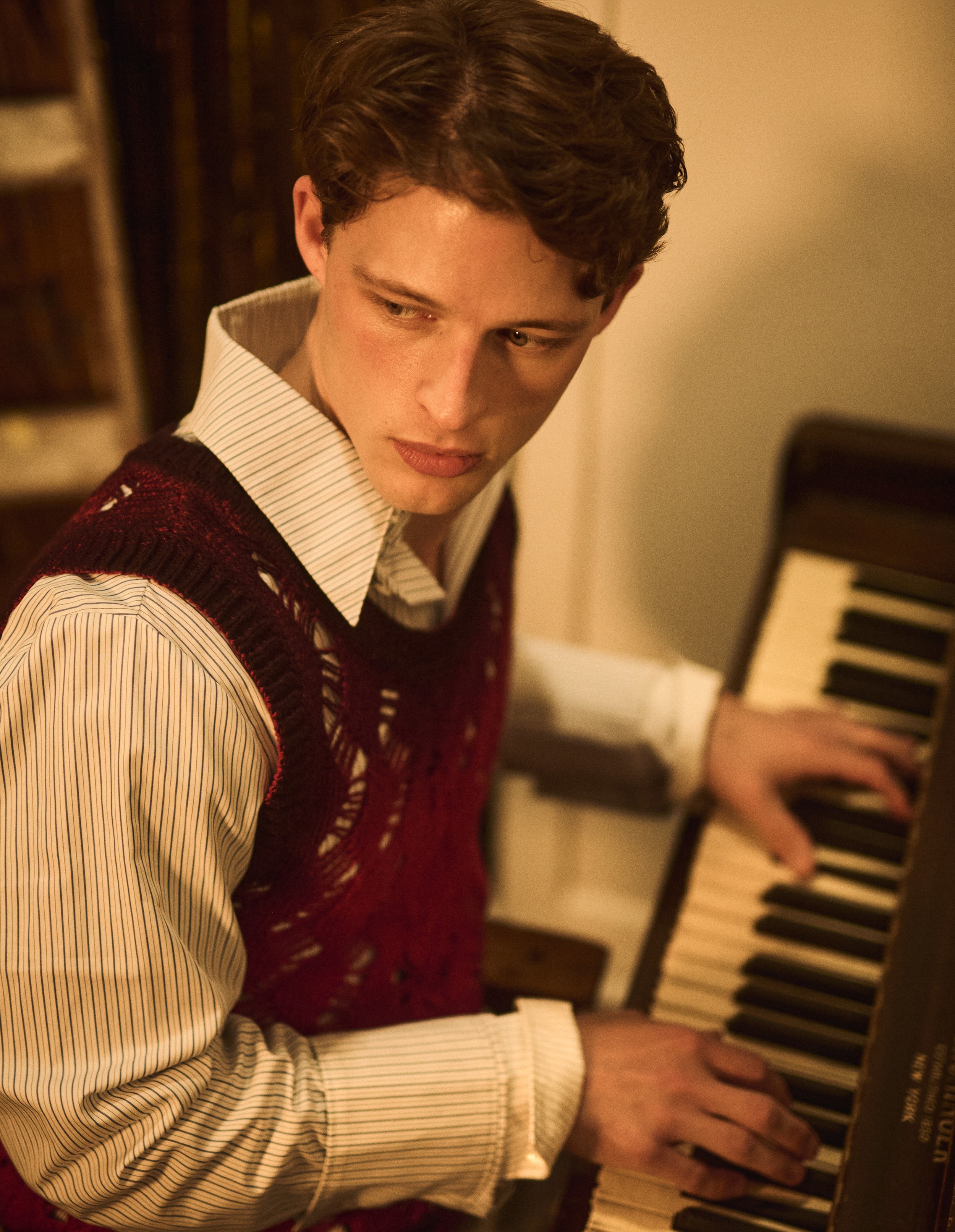
Total look EGONLAB.
That belief would carry him through the years that followed. After college came the version of an acting career that rarely makes it into profiles once an actor becomes recognizable: years of auditions, day jobs, rent, and waiting. Bloom describes nearly a decade of trying to reconcile the life he was living with the one he was certain he was supposed to have. He would be heading to a survival job, pass a billboard or subway advertisement for a television series and experience an almost physical sense that something was wrong. “I’d think, ‘Something’s off here… This isn’t right… I’m not supposed to be waiting tables, I’m supposed to be doing that.’”
It was an irrational thought that nevertheless felt completely rational to him. “I felt like I’d been body-swapped or had traveled into a parallel universe where instead of getting to act, I had to watch other people do it while I struggled to pay rent,” he says. He knew, of course, that no cosmic mistake had actually occurred. But the feeling persisted: “There’s been a mistake. That’s supposed to be me up there.”
Bloom admits there were “countless moments” when he wished he could want something else. The fantasy was less about abandoning acting than about imagining the relief of a conventional life: regular hours, stability, health insurance. At one point, he tried it. He took a membership-sales position at a luxury gym, hoping a more predictable job might give his life some structure. He lasted less than two weeks. It only confirmed how deeply he wanted the life he had chosen, uncertainty and all. What sent him back was not a promise that acting would eventually work out. It was the realization that success and a meaningful life were not necessarily the same thing. Bloom imagined reaching his 50th birthday without having moved any closer to his dream and realized that, even then, he wouldn’t consider the years spent pursuing it wasted. “I realized starting a new path could mean building a bigger life, but it wouldn’t be a life I wanted,” he says. So he returned to waiting tables. “My entire life is about taking that chance. Fingers crossed it keeps paying off.”
PROMOTION
Watch Line of Fire Mondays at 10/9c on NBC. Stream next day on Peacock.
New York did not make any of this easier. In fact, Bloom hated the city for his first four years here. Coming from Virginia, he arrived at a point in his life when he was still wandering, while New York seemed almost aggressively uninterested in letting him stay unfocused. “New York has a way of demanding focus,” he says. Eventually, his relationship with the city changed. The breakthrough came when he realized surviving here wasn’t necessarily about bending himself to fit New York. “Making a life here isn’t about finding how to adapt to New York,” he says. “It’s about finding how New York can adapt to you.”
That philosophy also describes Bloom’s relationship with acting. The years have not made him less ambitious, but they seem to have made him less interested in forcing things. That becomes particularly clear when he talks about the difference between performing onstage and working for the camera. For Bloom, theater is built around a kind of exchange. “There is a sacred relationship that unfolds on a live stage between a performer and the audience,” he says. At its best, that relationship is both “terribly alive and totally safe.” The audience is present. It holds the actor through the moment. “The camera can see beyond your craft and your ideas and your talent,” Bloom says. “Anyone tuning in at home can see into your soul if you let them.” For an actor whose earliest instinct was to disappear, there is an interesting symmetry in building a career around allowing himself to be seen. “Choosing to let them see is exposing beyond belief,” he says. “The difference is, you’re doing it alone, without the audience there to hold you. It’s a huge act of trust.”
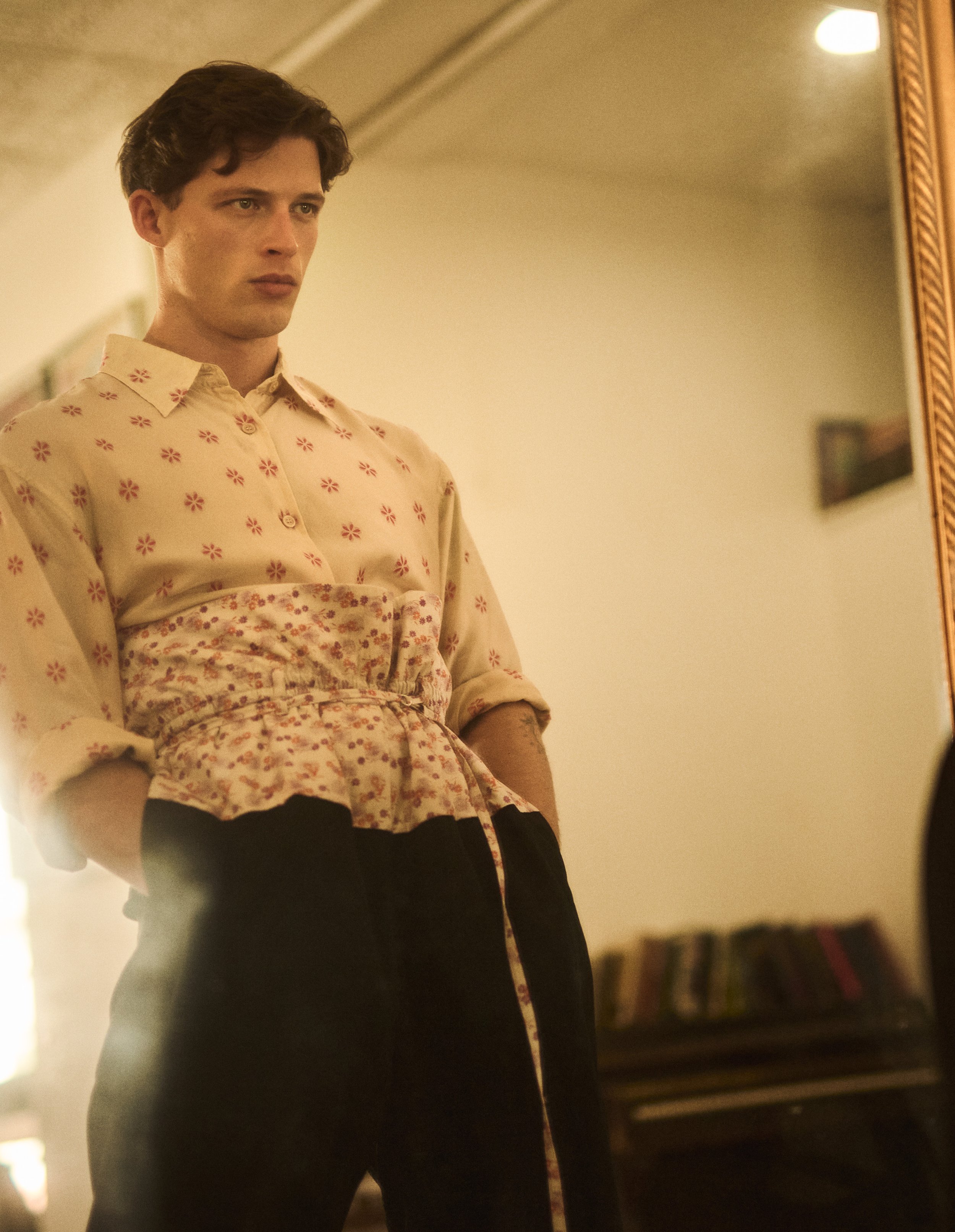
Total look DRIES VAN NOTEN.

Total look CELINE.
“ANYONE TUNING IN AT HOME CAN SEE INTO YOUR SOUL IF YOU LET THEM.”
— TAYLOR BLOOM ON THE INTIMACY OF THE CAMERA
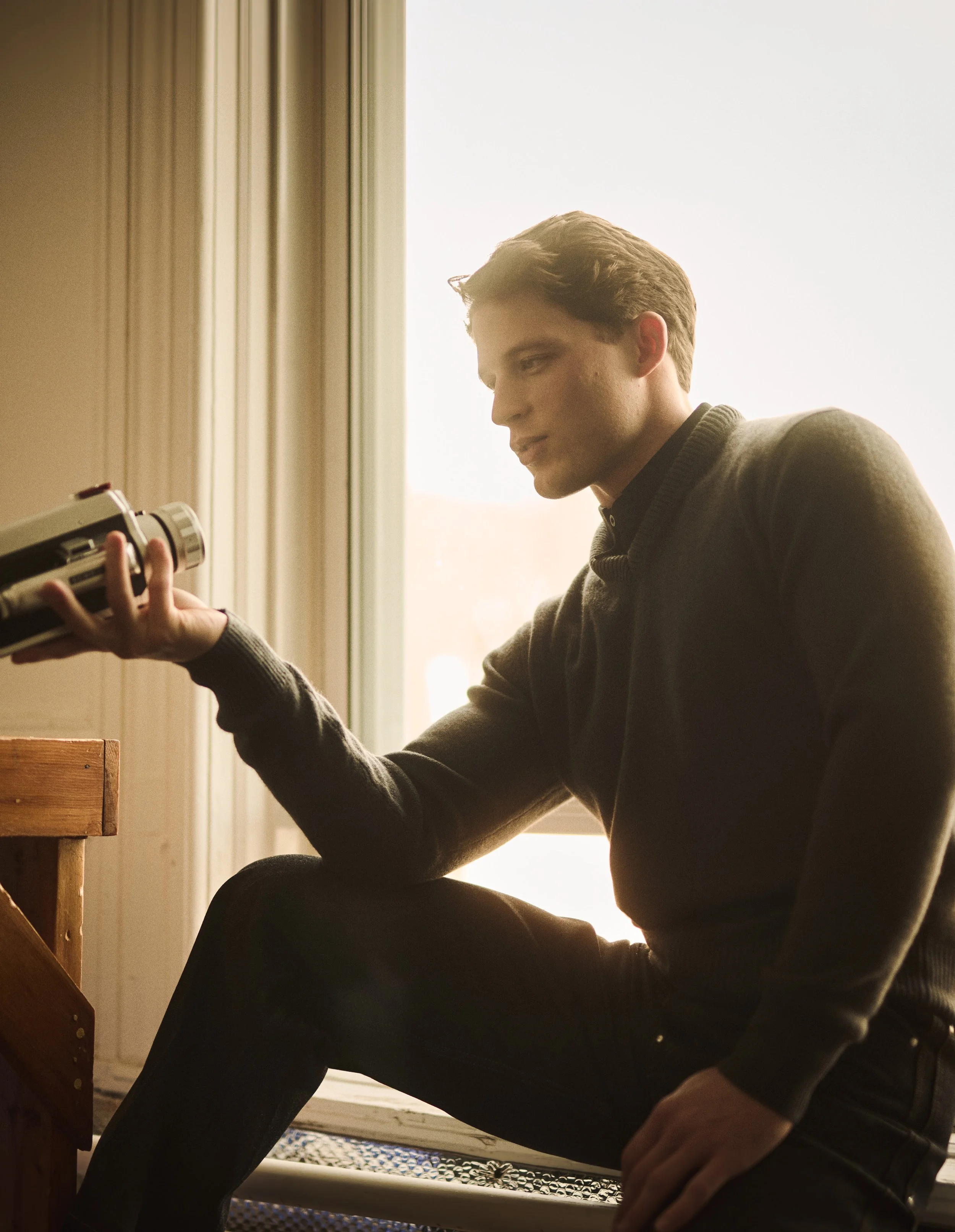
Total look LEMAIRE.
That trust now sits at the center of Line of Fire, where Bloom plays Russ Hollingsworth, the youngest member of a family whose professional and personal lives are shaped by questions of loyalty, protection and responsibility. What interests Bloom about Russ is not innocence so much as his refusal to surrender hope. “Russ’ optimism is one of my favorite qualities about him and something I understand on a deep level,” he says. “It’s not that he sees the world through rose-colored glasses, but that he believes that the broken parts in the world and its people can be mended.”
Bloom resists the idea that this optimism makes Russ naïve. For him, it’s the opposite. “It’s not naivety, it’s faith. It’s his superpower.” It is also one of the places where character and actor overlap. “It’s a quality I strive to embody in my personal life,” he says. “Though it’s not always easy, it’s always worth trying to find hope. If audiences see that in Russ, I’ll be happy with my part in the beautiful world of Line of Fire.”
That world has also given Bloom a new kind of family. He speaks warmly about Kat Cunning and Tommy O’Brien, crediting casting directors Jessica Daniels and Cassandra Kulukundis with recognizing something that extended beyond the individual performances. “Tommy, Kat and I really gel so beautifully,” Bloom says. What binds them, he believes, is not simply chemistry but a shared seriousness about the work: determination, discipline and gratitude. “Warmth, kindness and consideration mark our offscreen relationships, and that helps us to feel safe, play dirty and get real when we’re onscreen.”
Then there are Peter Krause and Hope Davis, two actors whose careers Bloom had been watching long before he found himself working beside them. He remembers growing up with Krause on Sports Night and Parenthood, and discovering Davis through the original Broadway cast of God of Carnage while studying acting in college. Now, proximity has changed admiration into something more practical. He can observe what longevity actually looks like from a few feet away.
“Peter and Hope are unparalleled examples of how to make a life in this business,” Bloom says. What impresses him is less the résumé than the way they work: “warm, focused, hard-working and dedicated.” Then he identifies the quality that may matter most. “Best of all? They love coming to work.” For an actor who spent so many years fighting simply for the opportunity to do that work, the lesson carries weight. “I can think of no better examples of the actors I’d like to emulate for the rest of my career.”
Off set, that groundedness is practical. “As an actor, whether employed or not, your body and your state of mind are basically all you have,” Bloom says, so his days are built around maintenance. He exercises in some form every day, usually at the gym. Coffee comes first, and his first survival job was as a barista, so he admits he’s still learning to let go of some of his third-wave coffee snobbery. A good day includes tennis and a bike ride from Brooklyn to Midtown, his current favorite route as an avid New York cyclist. A great day ends with cooking a beautiful dinner and, if he has no work for a couple of days, a glass of wine or a Negroni.
And despite television bringing him into more homes, Bloom finds himself thinking again about the place where all of this began. Being surrounded by New York actors appearing as guest stars on Line of Fire has pulled his attention back toward theater. More specifically, Shakespeare. “I miss playing Shakespeare,” he says. “I miss getting to plow the same row night after night and watch as the ruts grow deeper.” He hopes he will have the opportunity to return soon. For Bloom, it would be less a return to the past than another way forward, carrying everything the intervening years have taught him back onto the stage.
It is tempting to describe this point in Bloom’s career as an arrival. The word is neat, flattering, and probably too simple. An arrival suggests that everything before it existed merely as preparation for the moment when other people finally began paying attention. Bloom’s own account is more interesting. The waiting tables mattered. The auditions mattered. Hating New York mattered. Theater mattered. So did the strange certainty he carried while walking past somebody else’s face on a billboard and believing, against the available evidence, that there was a place for him up there too.
What has changed is that the external life is beginning to catch up with the internal conviction. The man who once felt as though he were watching his intended life happen to somebody else is finally doing the work himself. And unexpectedly, greater visibility has not left him feeling more unsettled. It has done the opposite. The survival jobs and the constant effort to be seen had been the destabilizing part. Acting, by comparison, feels like solid ground. “For me, this work is the foundation everything else gets built on. To be without it until now has been the greatest struggle. Now that the moment has come? I feel I’m finally at home in my own life.”
Creative Director & Photographer Kevin Sinclair, Fashion Editor Charlie Ward (See Management), Grooming Wesley O’Meara (Honey Artists), Editorial Associates Oprah Winfrey & Corwin Wilson,
Words Arnoldas Šmitas, Talent Taylor Bloom, Publicity Margaret Crane & Jackie Hernandez (NBCUniversal), Documented in Soho, New York.
BEHIND THE STORY: Photographing Taylor felt free, and that immediately shaped the story. We wanted the images to feel cinematic and less about constructing a character and more about allowing moments to develop naturally. Moving through the Soho space, the light, architecture, and vintage details became part of that rhythm. What stayed with me most was Taylor’s openness in front of the camera: confident without performing for it, present without overthinking the moment. The result feels like a portrait of an actor at an exciting point in his life, but also of the person standing just beyond the roles. Sometimes the strongest photographs happen when you give someone the space to be seen.
