

INSERT VALENTINO WINTER 2026
VALENTINO WINTER 2026: THE ART OF REINVENTION
Every fashion house carries its own history. Few carry it as visibly as Valentino. For Winter 2026, Alessandro Michele returns the house to Rome, where the past feels inseparable from the present. Centuries of architecture, art, and restoration exist under one roof, each leaving its own mark without erasing what came before. It becomes the perfect setting for Interferenze, a collection built on the belief that fashion is at its most interesting when different ideas are allowed to meet. Returning Valentino to its birthplace carries meaning beyond geography. Rome has always been part of the house's identity. Rather than treating that history as something to preserve behind glass, Michele approaches it as something still alive.
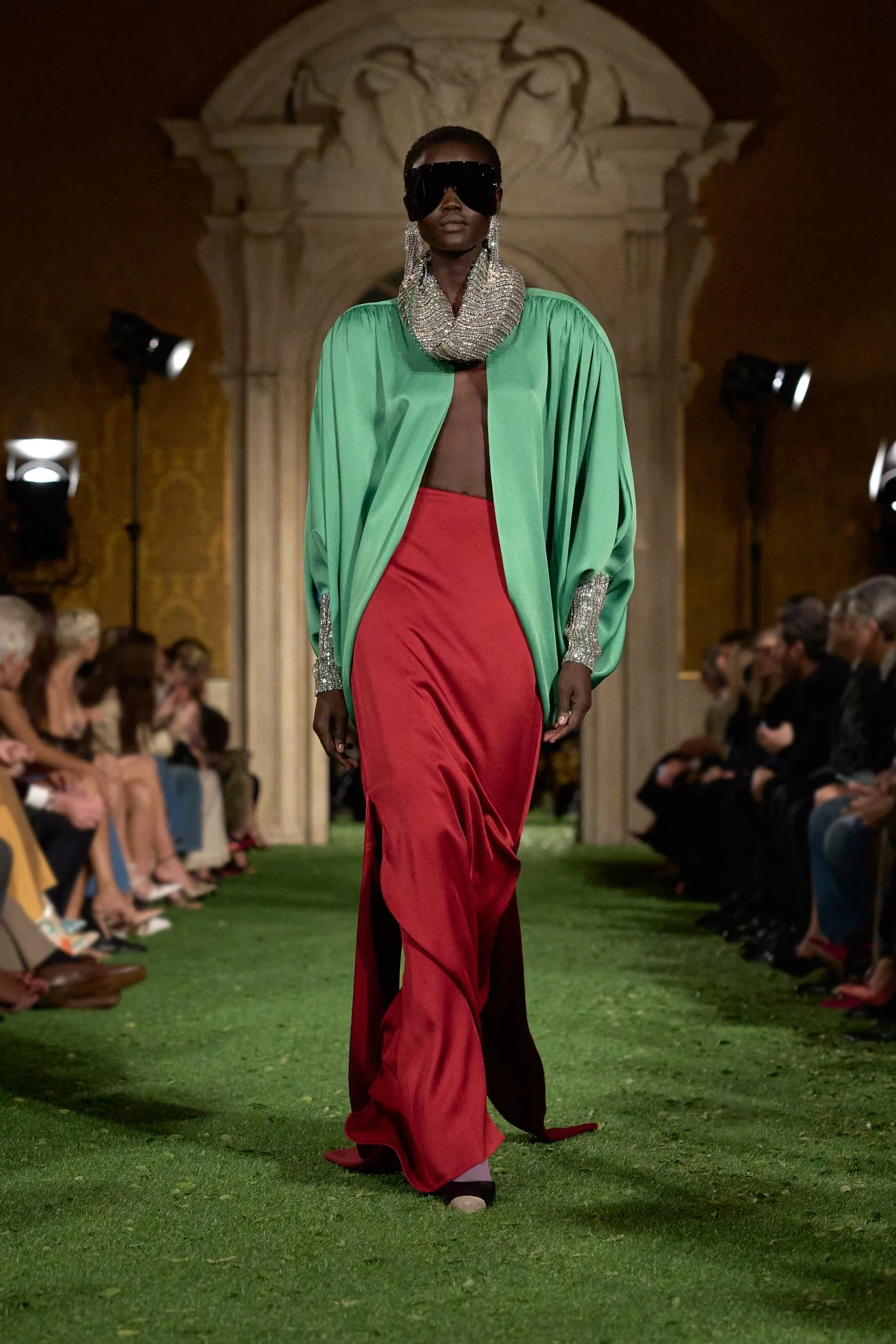
Every collection becomes another layer added to a much larger story. Rather than choosing between reverence and reinvention, he allows the two to exist together. Everything that follows grows naturally from that balance. The collection nods to the 1980s while keeping both feet firmly in the present. Broad shoulders introduce structure before giving way to fluid skirts. Draped coats bring softness, while lace appears where it is least expected. Skinny jeans trimmed in Chantilly lace challenge traditional evening dressing, while richly textured gowns reaffirm Valentino's enduring relationship with couture. It never settles on a single point of view. Instead, opposing ideas are allowed to exist together. Pale pink meets saturated purple. Apple green meets blood red. Tailoring shares space with transparency. Rockstud accessories return with a lighter touch, while dramatic evening silhouettes share the runway with relaxed menswear. Every contrast gives the next look greater clarity.
That same approach runs through Michele's relationship with Valentino itself; it feels as though he understands that heritage is something to work with, not around. The collection reminds us that great fashion houses are never built in a single moment. They are shaped over generations, with every designer leaving something behind for the next to discover.
Perhaps that is what Interferenze ultimately proposes. Great houses are never built by a single generation. They evolve through memory, curiosity, contradiction, and the willingness to let different ideas occupy the same space. Palazzo Barberini has carried those layers for centuries. Winter 2026 does the same, proving that the richest ideas rarely come from starting over. They come from knowing what is worth carrying forward.